

What Is Rank Tracking in SEO? A Developer's Guide
Rank tracking in SEO means repeatedly querying a search engine for a set of keywords and recording where a given domain appears in the results. It turns a volatile, personalized, location-dependent page into a time series you can chart, alert on, and tie back to revenue.
This article looks at what a SERP looks like once you stop treating it as ten blue links, and what it costs to build the data layer yourself versus buying it from a google rank tracking api.
If you build SEO tooling, this is the part that decides whether your product is trusted or quietly abandoned. Rankings are the number customers check first, and also the number they'll email you about the moment it looks wrong.
What Rank Tracking in SEO Actually Measures
A rank is not a property of a page. It's the output of a function with several arguments: the query, the location, the language, the device, the search engine, and the moment in time. So when someone asks what is rank tracking in seo, the honest technical answer is that it's the disciplined sampling of that function with the arguments pinned down.
A keyword tracked for "United States, English, desktop" is a different series than the same keyword tracked for "Chicago, IL, English, mobile." A rank tracking platform that doesn't expose those arguments to the user is hiding the only variables that explain the data.
There are three measurements worth storing per check, and most mature tools keep all three:
- Absolute position. The index of your result among all organic results on the page, counting from one.
- Pixel position or block position. Where your result sits relative to everything on the page, including ads, AI overviews, local packs, and video carousels. On multiple commercial queries, organic position 1 sits well below the fold once ads and other blocks are accounted for.
- SERP feature presence. Whether you own a featured snippet, a People Also Ask entry, an image result, a sitelink block, or a local pack listing for that query.
Storing only absolute position is how you end up telling a client they're "number one" on a query where the first organic result is invisible without scrolling.
Timestamps matter as much as positions. A rank record without a UTC timestamp, a location identifier, and a device flag isn't reproducible. Non-reproducible SEO data is the kind that gets argued about in quarterly reviews instead of acted on.
How a Rank Checker Works Under the Hood
Every rank checker, commercial or homegrown, runs the same four-step loop as part of a rank checker seo setup. The differences between products sit entirely in how well each step gets implemented.
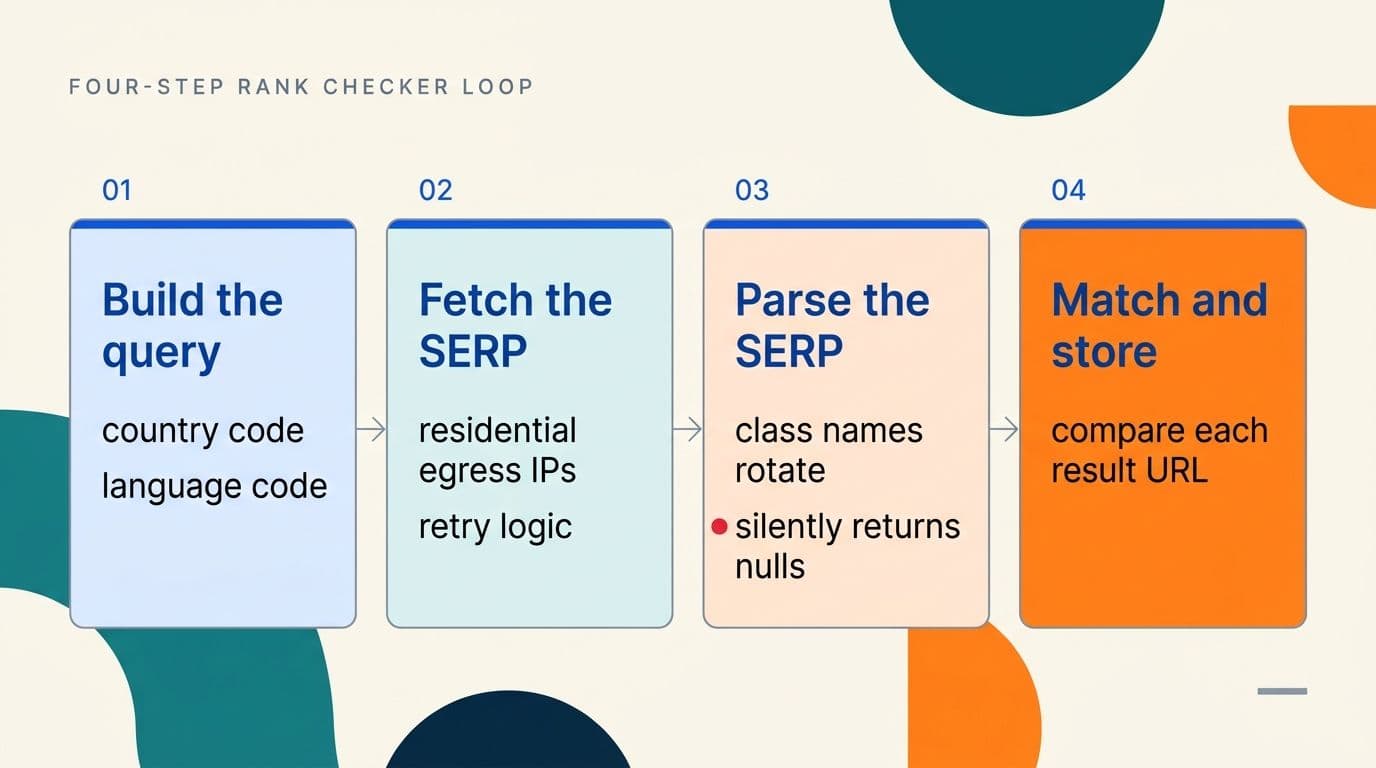
Step one: build the query. You take a keyword and attach parameters, typically a country code, a language code, a device type, and often a city or UULE-style geo encoding. A proper rank tracking system stores these as part of the keyword definition, not as a global setting. A single client may track German-language queries in Austria and English-language queries in Singapore within the same project.
Step two: fetch the SERP. This is where the engineering cost lives. Google does not want automated clients hitting results pages at volume. You need residential or mobile egress IPs that match the geography you claim to search from. You also need header and TLS fingerprints that survive inspection, JavaScript rendering for result types that load client-side, and retry logic that tells a CAPTCHA apart from a 429.
Step three: parse the SERP into structure. Class names get obfuscated and rotate. The same visual block renders from different markup depending on the test bucket your request landed in. CSS-selector scraping works for a month, then silently returns nulls that look like "your client dropped out of the top 100."
Step four: match and store. You compare each result URL against the domains you track, normalizing for protocol, www, trailing slashes, and parameters. You record position, URL, title, and feature context, then write it to a time series keyed on keyword, location, device, and date.
Steps two and three make up the bulk of the maintenance burden and are the main reason teams eventually outsource them. Steps one and four are your product. That split is the entire build-versus-buy argument in rank tracking for seo, and it's worth being clear-eyed about which side of it you want to spend your engineering hours on.
Why Two Rank Trackers Disagree About the Same Keyword
This question lands in support inboxes constantly. The answer is almost never "one of them is broken."
Different locations. Tool A defaults to a country-level search. Tool B geo-locates to a city. For anything with local intent, those produce different pages.
Different devices. Mobile and desktop SERPs have diverged for years. Mobile shows more AI-generated content and local results above organic listings. Desktop surfaces wider knowledge panels. Tracking only desktop while most of your traffic arrives on mobile measures a page most of your users never see.
Different counting rules. Does a featured snippet count as position zero, position one, or not at all? Do you count the sitelinks under a result as separate positions? Does a video carousel occupy one slot or six? Every tool picks a convention, and most don't document it.
Different freshness. This one matters most, because if your product sells daily movement alerts, cached SERP data means you're alerting on history.
Different personalization handling. Reputable rank tracking runs in a clean, unauthenticated context, but "clean" varies in practice.
When you build a rank checker, document your conventions and expose them. "Position 3, desktop, United States, organic-only counting, captured 2026-11-17T04:12Z" is a defensible number.
The SERP Is Not Ten Blue Links Anymore
If your rank-checking logic only parses organic results, you're measuring a shrinking fraction of the page. A typical commercial query in late 2026 can contain AI-generated summaries, shopping units, sponsored results, People Also Ask accordions, local packs, image rows, video carousels, discussion forums, and a knowledge panel, before a single organic listing.
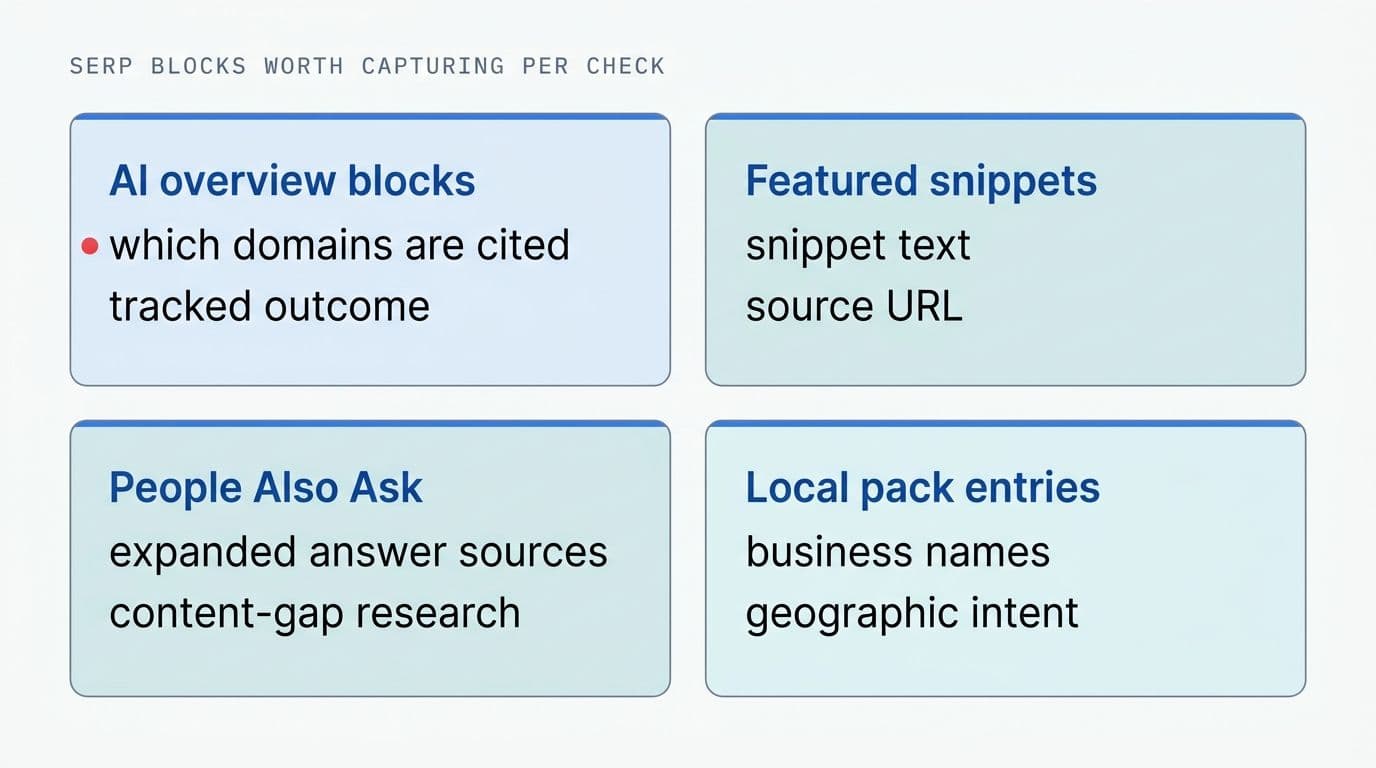
For modern rank tracking for seo, these are the blocks worth capturing per check:
- AI overview or generated answer blocks, including which domains are cited. Being cited in a generated answer is now a tracked outcome in its own right, distinct from organic position.
- Featured snippets, with the snippet text and the source URL.
- People Also Ask, with the questions and the expanded answer sources. This is content-gap research that arrives free with every rank check.
- Local pack entries, with business names and positions, for anything with geographic intent.
- Paid results, so you can tell a client that organic position 2 sits beneath four ads.
- Related searches, which feed keyword discovery without a individual data source.
Each of these is a discrete parser with its own failure mode, and each one breaks independently when Google ships a layout change.
This is the main argument for pulling structured SERP JSON from an API rather than parsing HTML yourself. You want the feature blocks already typed and named, so a layout change becomes your vendor's incident, not yours.
Build or Buy: The SERP Data Layer
The direct costs are proxy bandwidth, a rendering fleet, and a CAPTCHA strategy. The indirect costs are the ones that bite. Someone owns the parsers, someone gets paged when the block rate climbs on a Sunday, someone re-derives the geo-targeting logic when Google changes how location parameters resolve, and someone explains to customers why Tuesday's data is missing.
Buying means calling a google rank tracking api that returns structured results. That frees your engineering time for the parts customers actually see: competitor sets and share-of-voice reporting that a marketing director can forward without editing.
Pricing models are the thing to scrutinize, because the one you pick determines whether your margins survive scale.
Credit-weight transparency is the specific thing to look for. You want to know what an endpoint costs before you run it, not after you reconcile an invoice. Our Google SERP API publishes endpoint weights up front, failed requests that return no data don't cost a credit, and top-up credits never expire while monthly credits reset each period. Plans start at $29/mo for 40,000 credits and run to $299/mo for 1,150,000 credits, with 1,000 one-time signup credits free and no credit card required.
The other thing to check is whether results are live. We run live search on every request rather than serving a cache, which for rank tracking is the difference between a number you can alert on and a number you can only report.
Working With a Google Rank Tracking API
A SERP API for rank tracking should accept a query plus the parameters that determine which SERP you get: country, language, device, and location granularity down to the city where available. Our coverage spans 100+ countries with localization by city, language, and device. It's not every micro-locale in existence. There are 195+ countries, and we don't claim all of them, so if your tracking set concentrates in a very specific regional market, check coverage before you migrate.

The response you want back is structured JSON with organic results as typed objects, plus separate arrays for the feature blocks described above. That's what keeps a rank-tracking pipeline maintainable. Your matching logic reads organic_results[i].link, not a CSS selector that assumes a particular div nesting.
For exact endpoint paths, parameter names, and response fields, see the docs at docs.datablue.dev. We're deliberately not reproducing a request signature from memory here, because a parameter name that's one character off costs you more time than reading the reference page.
Three implementation notes apply regardless of vendor.
Schedule by priority, not uniformly. Head terms that drive revenue justify daily or twice-daily checks. The long tail is fine weekly. Tracking 10,000 keywords daily when 9,000 of them move twice a year is how rank tracking budgets get cut.
Store the raw structured response, not just the extracted position. Disk is cheap and re-deriving a metric from stored JSON is free. Re-querying a SERP from three months ago is impossible.
Make the matching logic strict and the reporting logic forgiving. Normalize URLs hard at match time. Then, in reporting, show the matched URL alongside the position so a user can see immediately when a different page on their site started ranking for a term.
RankMax runs its SEO rank-tracking layer on our Google SERP API. You can read how that integration is structured on the RankMax customer page, which covers the data flow from keyword set to stored position in more detail than fits here.
Migrating an Existing Rank Checker to a New Data Source
Map your existing provider's field names to the new ones, then run both providers in parallel against the same keyword set for a week.
Compare positions daily and investigate any delta greater than two positions. In our experience the gaps are almost always a location or device parameter that didn't carry over, not a data quality problem. Once the series agree, cut over and keep the old provider for a billing cycle as a fallback.
We're not a full proxy, unblocker, and dataset product line, and we don't hold SOC 2 Type II or ISO 27001 certification today. Both sit on the roadmap, not in hand.
For a side-by-side look at how the options compare on pricing model, freshness, and output format, read our google search api alternative comparison.
Where Rank Tracking Fits in a Larger SEO Data Stack
Rank tracking answers "where am I?" It doesn't answer "why" or "what next." Those questions need the page content behind each result, which is a scraping problem rather than a SERP problem.
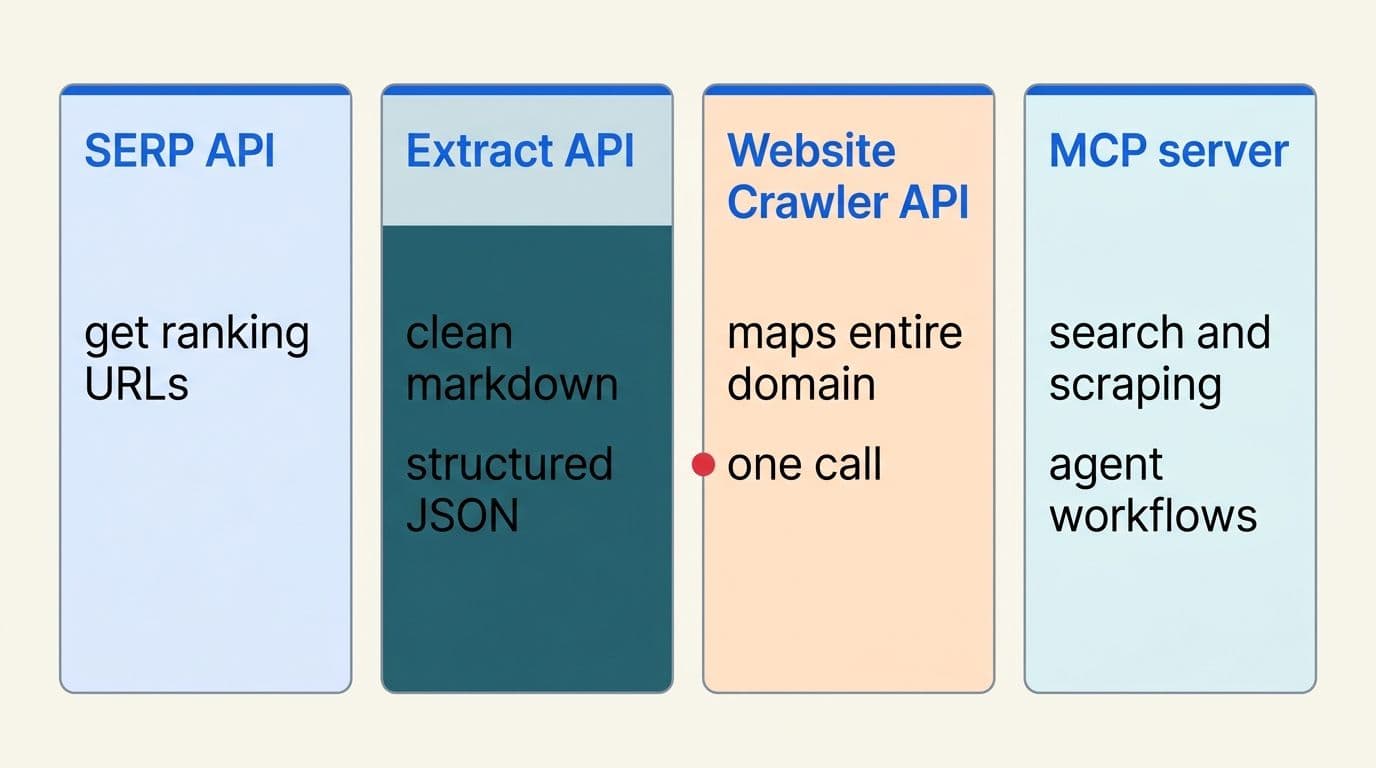
The pattern most mature SEO platforms converge on: use a SERP API to get the ranking URLs, then fetch and parse those URLs to analyze what's actually ranking. Word count, heading structure, schema markup, internal link patterns, publish and update dates all matter here. Our Extract API returns any URL as clean markdown or structured JSON, which is the practical format for feeding competitor pages into an LLM for content-gap analysis without burning tokens on navigation chrome and cookie banners.
For broader site-level work, the Website Crawler API maps an entire domain in one call. That's how you build technical audits and internal-link reports alongside your rank data.
And if your product has an agent layer, our MCP server exposes search and scraping as tools inside agent workflows, so an assistant can check a position and pull the competing page in the same conversation.
The underlying mechanics of fetching and parsing Google results apply to every one of these use cases. If you want the full technical walkthrough of that layer, our guide to web scraping Google search results covers request construction, parsing structure, and the failure modes to plan for.
One honest caveat on the whole category: scraping isn't automatically permissible regardless of a target site's terms, and no provider can guarantee block-free collection in every case. Build retry and gap-handling into your pipeline, and treat a missing data point as a known state rather than an error to hide.
Start Building
Rank tracking is a simple idea with a hard middle. The query construction and the time-series storage are straightforward. The fetching and parsing in between is a specialist, adversarial, permanently-changing problem, and it's the part that eats roadmaps.
Decide which half you want to own. If it's the product half, a growing number of developers have built on our APIs, and you can test a live SERP response against your own keyword set in a few minutes.
- Get Your API Key. 1,000 free signup credits, no credit card
- Read the Docs. Exact parameters and response fields
- See Pricing. Credit weights published per endpoint
- Book a 30-min demo. If you are scoping a migration