

Is Scraping Google Search Results Legal?
Short answer: scraping Google search results isn't a crime in most situations. But it does breach Google's terms of service, and Google is actively suing scrapers right now. Those two facts aren't in conflict. They just mean the risk is contractual and civil, not criminal, for the overwhelming majority of teams doing it.
That distinction matters because it changes how you build. If you think you're one request away from a federal charge, you over-engineer. If you think scraping public data is a free-for-all, you get a cease-and-desist and lose a product line. This guide lays out where the law actually sits in late 2026 and covers what the current wave of google scraping lawsuits is really about. It also shows how to build rank tracking or SERP monitoring that survives both the legal and the technical side.
Is scraping Google search results legal under US law?
Scraping publicly visible web pages, including search results, has never been established as inherently illegal in the US. The governing question for years has been whether unauthorized scraping triggers the Computer Fraud and Abuse Act. The answer the courts settled on is narrow. CFAA web scraping claims generally fail when the data is public and no login or technical authentication barrier is bypassed. The hiQ v. LinkedIn line of cases pushed "without authorization" toward meaning something closer to hacking past a password, not ignoring a cease-and-desist letter about public profiles.
So when someone asks "is web scraping illegal," the accurate answer for public SERPs is no, not under the CFAA, as long as you aren't logging in, using stolen credentials, or touching anything gated. That's the floor.
The ceiling is different. Google's own position doesn't rest on the CFAA. It rests on contract, their terms, plus copyright and, increasingly, the anti-circumvention provisions of the DMCA. That's the shift worth paying attention to, and it's the part most articles on google search results scraping legality still haven't updated for.
What the current google scraping lawsuits actually claim
Google has moved from blocking scrapers to litigating against them. The scale of the scraping being alleged is what pushed it there. The volume of automated SERP collection running today is large enough that it reads as a direct cost and competitive threat, not a nuisance.
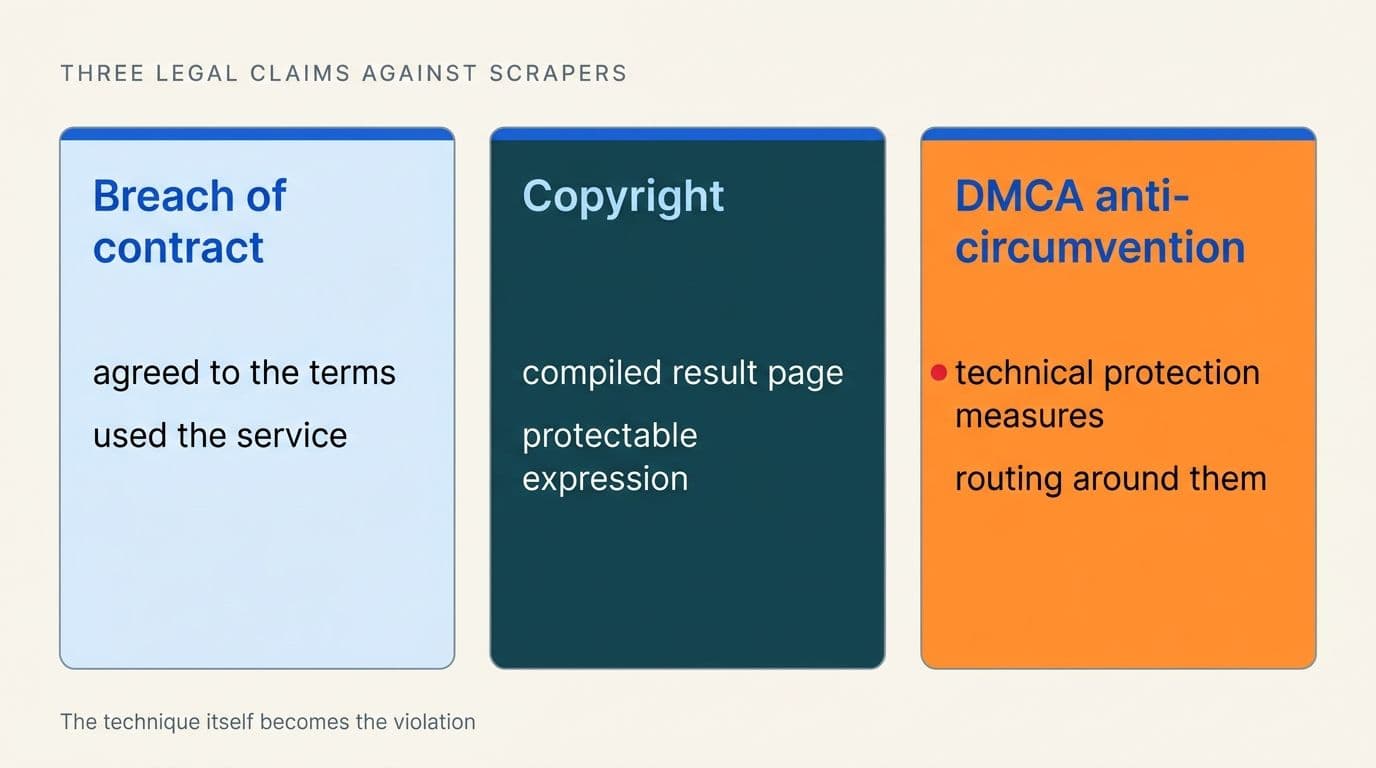
The claims being filed are layered. There's breach of contract: you agreed to the terms when you used the service. There's copyright, on the theory that the compiled result page, snippets, and ranking arrangement carry protectable expression. And there's the DMCA anti-circumvention angle, which argues that bot detection and challenge pages are technical protection measures, and that routing around them is unlawful circumvention under this theory regardless of whether the underlying data is copyrightable.
That third claim is the unsettled one. Courts are currently working through whether evading anti-bot defenses on a public page counts as circumvention in the statutory sense. It's a genuinely open question. If it lands in Google's favor, the legal risks of scraping search engines change shape for everyone who runs headless browsers, rotates fingerprints, or solves challenges. The technique itself becomes the violation, not the data.
A parallel question has been circulating since the hiQ-era rulings: does permission to scrape public data extend to scraping it for AI model training? Nothing in the CFAA case law speaks to downstream use. Training rights are governed by copyright and licensing, and the disputes over Google's protection measures and content licensing terms through 2026 have made that boundary messier, not cleaner. Treat "we may scrape it" and "we may train on it" as two separate decisions.
Google terms of service scraping: what you're actually agreeing to
Google's terms prohibit automated access to Search outside of approved interfaces. That's unambiguous and has been for a long time, and the claim that scraping under google terms of service is permitted simply doesn't hold up.
What's worth being precise about is the consequence. Breaching terms is a civil contract matter, and the standard remedies are account termination, IP and ASN blocking, and injunctions. Damages claims follow if Google chooses to escalate. It's not a criminal exposure in itself.
The practical risk profile for a small SEO tool pulling a few thousand keywords a day is very different from a service reselling millions of SERPs. Scale and commercial substitution are what attract attention.
Then there's robots.txt, which people keep treating as law. It isn't. It's a voluntary convention with no independent legal force in the US. But it is evidence. Ignoring an explicit disallow makes it much harder to argue you believed access was authorized, and it reads badly in front of a judge. Follow it where you can, and if you don't, know exactly why.
How search engine crawlers get treated differently
Here's the asymmetry that frustrates every builder. Google's crawler reads the open web at enormous scale, and Google blocks others from reading its results. That isn't hypocrisy in a legal sense, it's two different positions. Googlebot operates under a widely accepted robots.txt opt-out convention, publishes its IP ranges, identifies itself honestly, and respects crawl-delay signals. Publishers can exclude it in one line, and many do.
Scrapers that spoof user agents and rotate residential IPs while hiding origin are doing the opposite of that. Even if the data is public, the posture is adversarial, and courts notice posture. The practical takeaway is that the closer your scraper behaves to an honest, identifiable, rate-limited crawler, the stronger your position on scraping google SERP risks. Identify yourself where you can, honor rate limits, and don't log in or take gated content.
Technical compliance: building a scraper that doesn't look like an attack
Legal defensibility and not getting blocked turn out to be the same engineering problem, which is convenient.
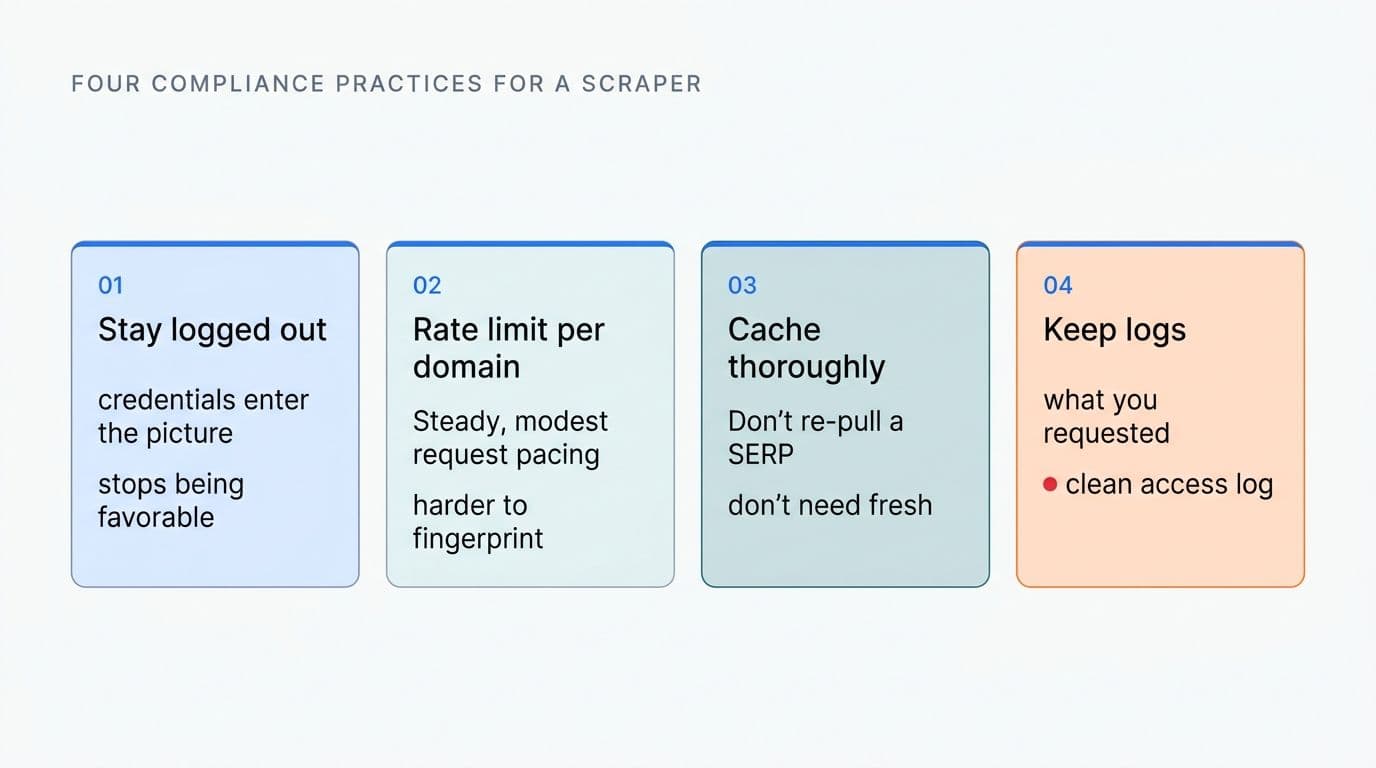
The baseline practices:
- Stay logged out. The moment credentials enter the picture, the CFAA web scraping analysis stops being favorable to you.
- Rate limit per target domain, not globally. Steady, modest request pacing is both politer and harder to fingerprint.
- Cache thoroughly on your side for anything you don't need fresh. Don't re-pull a SERP you already have.
- Keep logs of what you requested, when, and from where. If a dispute ever arises, a clean access log is the difference between "we ran a measured crawl" and "we have no idea what our fleet did."
- Store what you need, not everything. Rankings, URLs, and SERP features are facts. Full snippet text and images carry more copyright weight.
- Re-read the target's terms periodically. They change, and compliance checks belong in your monitoring stack alongside uptime and parse-failure alerts.
That last point is underrated. Build a small job that flags parsing failures, sudden block-rate increases, and changes to the robots file of anything you touch, since compliance drift is silent otherwise.
Fleet management, proxies, and the cost-benefit math
On the technical side, the traditional wisdom that you need residential proxies to scrape Google at scale is softer than it looks. Disciplined fleet management can reach Tier 1 properties without paying for residential exit nodes at all. That means multiple concurrent scrapers, each with its own unique IP, a consistent spoofed browser profile, its own cookie jar, and randomized timing between requests. The failure mode in most homegrown scrapers isn't IP reputation. It's that a hundred workers share one fingerprint and fire in lockstep.
But proxies and fleets are only the first problem, and the real cost is everything downstream. Per-city and per-language localization, retry logic, and CAPTCHA detection separated from generic failures all add up fast. Add block detection that distinguishes a soft throttle from a hard ban, plus the parser rewrite you'll owe every time Google ships a layout change. Residential proxies are worth building around only if you're prepared to own that whole stack permanently. If you aren't, a SERP API is cheaper than rebuilding it, and we mean cheaper in engineer-hours, which is where the money actually goes.
The market price for raw volume is low. A one-time pull of ten thousand Google results can run a couple of dollars on the cheapest endpoints available, and no in-house team gets near that once you load salary against it. Paid APIs earn their margin through structured output and localization coverage, with someone else absorbing the parser churn. Worth noting given the litigation climate: that also moves the operational exposure off your infrastructure.
We built DataBlue's Google SERP API to be the boring part of that stack: live search on every request with no stale cache, structured JSON instead of HTML you have to parse, and coverage across 100+ countries localized by city, language, and device. RankMax runs its entire SEO rank-tracking layer on it. We don't cover every micro-locale, 100+ countries out of 195+, and if your use case lives in a gap, build for it directly. If you're weighing hosted options against each other, our google search api alternative comparison lays out the tradeoffs without the sales gloss.
One practical note: news results and maps data are usually better pulled through a general scraping API than a search-only endpoint, since the page structures and refresh patterns differ enough that a SERP parser handles them badly. Our walkthrough on web scraping Google search results covers that split.
Where we'd draw the line
If you're building rank tracking, SERP feature monitoring, or contested research, you're in the normal range of what thousands of tools do every day. Whether that kind of work runs afoul of google search results scraping legality standards usually comes down to contract terms, not criminal statutes, and you're almost certainly not facing CFAA exposure. The practical risk is being blocked rather than sued.

Raise your caution level if you're reselling raw SERPs at volume, reproducing snippet text verbatim, or feeding scraped results into model training. Those are where the active google scraping lawsuits are aimed, and where the DMCA circumvention theory bites hardest.
We're a scraping and SERP platform, not a law firm, and we won't pretend scraping is legal regardless of what a site's terms say, because it isn't. What we can tell you is where the enforcement actually lands and how to build so you're on the defensible side of it.
Thousands of developers have built on DataBlue. Signup is self-serve with 1,000 free credits and no card, endpoint weights are visible before every run, failed requests that return no data don't cost a credit, and top-up credits never expire.
Start Free · Get Your API Key · See Pricing · Read the Docs · Book a 30-min demo