

Google Search API Alternative: The 2026 Comparison for Developers
If you landed here, you already know the problem. Google's Custom Search JSON API was never a real SERP feed. As of 2026 it isn't even a cheap way to get a key anymore. Free keys stopped being issued under Google's newer policy. That pushed a lot of hobby projects and production pipelines into shopping for a google search api alternative at the same time.
This guide compares the options the way you'd actually evaluate them. We look at what data you get back, what a usable result costs, and how current it is. We also cover how it behaves in non-English locales and how much work migration takes. We build and sell one of these products, so we've put ours first and been specific about where it doesn't fit.
The Short Answer: Which Google Search API Alternative to Pick
Three buckets, and your use case decides which one you're in.
You need rankable Google results. Positions, SERP features, local packs, People Also Ask, ads, pagination past the first page, per-city and per-device control. That's a dedicated Google SERP API, and this is the bucket rank trackers, SEO platforms, and competitive-monitoring tools live in. Our Google SERP API is what RankMax runs its rank-tracking layer on, with real-time queries, structured JSON, and coverage across 100+ countries localized by city, language, and device.
You need text an LLM can read. Position 7 versus position 9 doesn't matter here. What matters is the agent getting clean, relevant passages with few tokens wasted. That's a semantic search layer, and the comparison that matters is google search api vs tavily, not which vendor parses the organic block best.
You need both. Most agent pipelines do. Use a search API for rankings and discovery, then a separate crawler or extraction call for the handful of pages that need deep inspection. Splitting those two jobs is cheaper and more reliable than asking one endpoint to do both.
Everything below is the detail behind those three sentences.
What Actually Happened to Google's Custom Search API
The discontinuation question needs clearing up, because the rumor mill is noisier than the facts.

Google has not published a hard shutdown date for the Custom Search JSON API. What changed is access: new free API keys are no longer handed out under current policy, which is why a lot of developers discovered the problem the hard way. A project that worked last year won't provision a key this year. Treat it as a quiet access squeeze rather than a dated end-of-life announcement, and don't architect around a shutdown timeline nobody has published.
The deeper issue predates all of that. The Custom Search API never returned google.com's actual search results. It returns results from a Programmable Search Engine, a custom index configured by you, which drifts from the live SERP in ways that break anything position-sensitive. You get no ads, no local pack, and no AI Overview. There's no People Also Ask, no knowledge panel, and no device or city targeting. Results are capped at 10 per request and 100 per query, which makes deep pagination impossible.
So when people search for a google custom search api alternative, they usually aren't asking for a drop-in replacement with the same shape. They're asking for the thing they thought they were buying: the real SERP, structured, at volume. That's a different product category, and pricing it as "replace CSE" undersells what you get.
Rankable Results or Semantic Answers? Decide This Before You Compare Vendors
This is the fork in the road, and teams that skip it end up benchmarking products that don't compete with each other.
A SERP API gives you the page Google served. Ten-ish organic results with positions, plus whatever SERP features appeared, plus pagination. It does not tell you which result answers the question, since that's your job downstream.
A semantic search API, the category Tavily, Exa, and similar services sit in, gives you ranked passages chosen for query intent, usually with the boilerplate already stripped. It doesn't tell you where anything ranked on Google, because that's not what it indexes.
Framed as google search api vs tavily, the honest comparison is this. If your output is a rank report, a SERP-feature alert, a share-of-voice chart, or anything a client will check against what they see in their browser, a semantic layer cannot do the job no matter how good its retrieval is. If your output is an LLM answer with citations, Google positions are a weak proxy for relevance and you'll burn tokens on navigational junk.
The practical pattern for agents: use a search API to get candidate URLs and rankings, filter them with your own logic, then fetch only the pages that matter with a browser-based crawler. Our Extract API returns clean markdown or structured JSON per URL for exactly that second stage, and the MCP server exposes both as tools inside agent workflows. Separating search from retrieval is the single biggest quality and cost win we see in agentic pipelines.
SERP API vs Google's Own API: What You Actually Get
Here's the comparison in table form. This is the serp api vs google question stripped of marketing on both sides.
| Google Custom Search JSON API | Dedicated Google SERP API | |
|---|---|---|
| Data source | Programmable Search Engine index | Live google.com results |
| Positions | Within your custom engine | Real organic positions |
| SERP features | None | Local pack, PAA, ads, AI Overview, shopping, news |
| Localization | Coarse country/language params | City, language, device, country |
| Pagination | 10 per call, 100 per query ceiling | Deep pagination supported |
| Freshness | Index-dependent | Fetched at request time |
| Free access | No new free keys under current policy | Trial credits, then paid |
| Parser maintenance | Google's problem | Vendor's problem |
That last row is worth more than it looks. The reason developers move off raw scraping and off thin wrappers isn't per-request price. It's that Google reshuffles its layout constantly, and every reshuffle breaks a selector somewhere. The ongoing cost of a scraping stack is parser rebuilds, not bandwidth. A serp api alternative earns its margin by absorbing that churn so your schema stays stable while the HTML underneath changes.
The flip side, and we'll say it plainly: a SERP API is a dependency. You're trusting someone else's parser, someone else's unblocking, someone else's uptime. Pick a vendor whose output schema you can map cleanly to your internal model, so swapping is an afternoon's work rather than a quarter's.
Google Search API vs SerpApi: What the Comparison Comes Down To
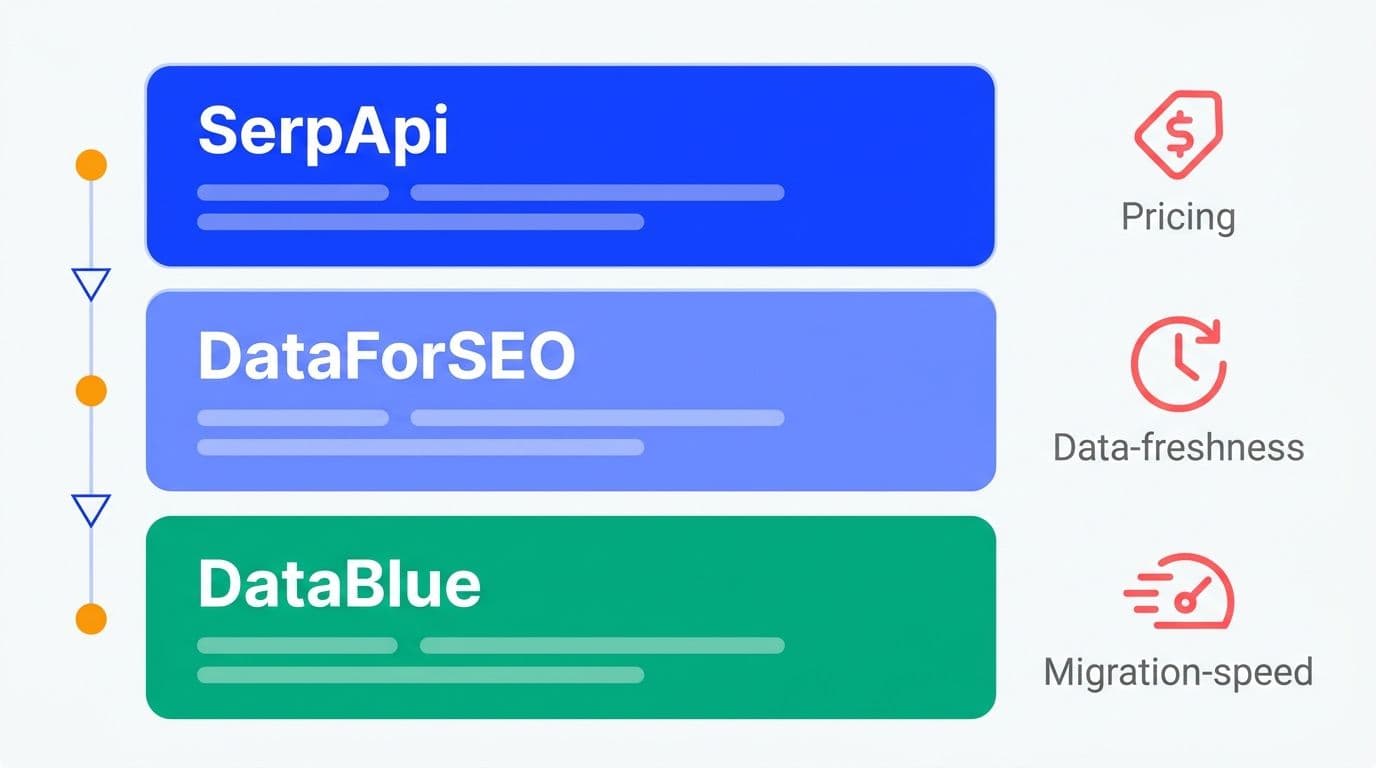
People type google search api vs serpapi expecting a feature matrix, but the features converge while the pricing models don't.

Google's offering is index-limited and now effectively closed to new free use. Every dedicated vendor, including SerpApi, DataForSEO, and us, returns live or near-live SERP JSON. Where they diverge:
Billing unit. Some bill per search, some per task, some per record returned, some with multipliers for "advanced" features that aren't disclosed until the invoice. If you can't predict the cost of a run before you execute it, you can't budget a rank tracker.
Credit expiry. Monthly credits that vanish at period end are normal. Prepaid top-ups that also expire are the thing that quietly costs teams money during a slow month.
Failed requests. Ask whether a request that returns no usable data still bills. At rank-tracking volume this is a real line item, not a rounding error.
Queue vs real-time. Task-based APIs that enqueue a job and call you back are fine for nightly batches and painful for interactive products.
On DataBlue: endpoint weights are visible before each run, so you know what a call costs in credits before you fire it. Requests that return no data don't consume a credit, and top-up credits never expire while monthly credits reset each period. Plans run from $29/mo for 40,000 credits up to $299/mo for 1,150,000. Self-serve signup, no minimums, no annual contract.
The serpapi vs google api framing is really a question about whether you want an index or a feed. The vendor comparison is a question about whether you can predict the bill.
The Real Cost: Price Per Usable Result, Not Per Request
Benchmark cost per usable result, because it's the only number that survives contact with production.
Here's why per-request pricing misleads. A cheap endpoint that returns ten thin organic links may need three or four calls, think page two, a refined query, a related query, before your pipeline has enough context to act on. A more expensive endpoint that returns the full SERP with features in one shot can be cheaper per unit of work. For one-off bulk pulls, some of the cheapest APIs on the market advertise prices for ten thousand Google results that look like a genuinely good deal when the job is "dump this once and never again," though we'd suggest checking current vendor pricing pages rather than taking any single number as fixed. It's a poor basis for choosing a provider you'll depend on daily.
The costs that don't appear in anyone's pricing table:
- Parser maintenance if you're scraping yourself, charged in engineer-days every time Google moves something.
- Retry overhead when blocks and empty responses still bill.
- Latency tax in interactive products, where a slow provider turns into a timeout and a retry and a second charge.
- Normalization work when a vendor's JSON doesn't map to your schema and you maintain a translation layer forever.
- Overage behavior. Does the API hard-stop, throttle, or silently bill?
Model a month of your real workload against each shortlisted provider before you sign anything. Real testing against your own query set tells you more than reputation does, because latency, coverage, and extraction quality vary between providers in ways no review captures.
Is There a Google Search API Alternative Free Tier Worth Using?
Short version: a google search api alternative free of charge, forever, at production volume, does not exist. Google search results are expensive to fetch at scale, with proxies, rendering, and retries all adding up, and anyone offering unlimited free access is either tiny, about to change their pricing, or serving you cached data.
What does exist, and is genuinely useful, breaks down into three paths. Trial credits give you enough to run your own benchmark on your own queries. We give 1,000 one-time signup credits with no credit card, which is sized for exactly that: wire it up, run your real query set, check the JSON against what you see in a browser, then decide.
Small monthly free tiers are common across the category, usually a few hundred searches. Fine for a side project, not fine for a rank tracker with a hundred clients.
Self-hosted scraping is free in dollars, expensive in hours. See the DIY section below.
If you're an indie hacker, a google search api alternative free tier plus a weekend is a reasonable starting point. Burn the credits on the hardest queries you have rather than the easy ones. If you're building a product with paying customers, price the paid tier now, because the migration from "free thing that worked" to "paid thing under load" always lands at the worst possible time.
Rolling Your Own: When DIY Scraping Is and Isn't Worth It
We'd rather you went in with clear eyes than bought something you don't need.

Plain HTTP requests against Google get captchas within roughly twenty requests. That's the wall everyone hits. From there you have two choices: add headless Chrome and a proxy pool, or stop. Headless browsers solve rendering, not identity. You still need residential IPs, sane request pacing, and header fidelity to look like a person.
Residential proxies are only worth implementing if you're prepared to own the whole chain. That means localization parameters, retry policy, captcha detection, block detection, and parser updates every time Google changes markup. Miss one and you get silent degradation, results that look fine and are quietly wrong, which is the worst failure mode for a rank tracker because nobody notices until a client does.
For one-off pulls, outsourcing is almost always the right call. The engineering time to build rotation and retry logic costs more than the API bill for a job you'll run once.
For long-running services, it's a build-versus-buy call with a hidden term. You're not building a scraper once, you're signing up to maintain parsers indefinitely. That ongoing maintenance, not the per-request price, is what pushes most teams toward a serp api alternative eventually.
If you want to see what the DIY path involves before deciding, our guide to web scraping google search results walks through the mechanics honestly, including where it breaks. No provider, including us, bypasses every captcha in every case. Anyone who claims that is selling you something.
Migrating from Google Custom Search API With Minimal Code Changes
The migration fear is usually bigger than the migration. Most codebases touch the search provider in exactly one module.
The pattern that keeps it small: put an adapter between your application and whatever provider you call, normalize to your own result shape, and never let provider field names leak into business logic. If you already have that, swapping providers is a config change. If you don't, writing it is the migration.
Example, an illustrative adapter that normalizes any provider's result array into one internal shape, so the rest of your app never sees vendor-specific field names:
const FIELD_MAP = { cse: { url: "link", title: "title", snippet: "snippet" }, serp: { url: "url", title: "title", snippet: "description" }};function normalize(rawResults, provider) { const map = FIELD_MAP[provider]; return rawResults.map((r, i) => ({ position: i + 1, url: r[map.url], title: r[map.title], snippet: r[map.snippet] }));}Run it against both providers' sample payloads and you should get identical internal objects, with the only difference being that real SERP positions replace index order.
Three things to plan for beyond field mapping. Pagination semantics differ, since a 100-result ceiling per query disappears when you move to deep pagination, so your loop conditions change. Positions become meaningful, which means you probably want to persist them now. And localization parameters are richer than country plus language, so decide your default locale explicitly rather than inheriting whatever the old API assumed.
Our response schema is Firecrawl-compatible, which makes mapping mechanical if you're coming from that stack. We've seen customers move substantial keyword volumes off SerpAPI in well under a day once their adapter layer was in place. Any good google custom search api alternative should be able to tell you what your migration touches before you start. Ours can, via Compare My Provider.
Freshness and Real-Time Indexing: Who Sees New Content First
Nobody advertises cache policy, and it's the thing that silently ruins rank trackers and news monitors.
There are two different freshness questions, and vendors conflate them.
Does the provider fetch live, or serve a stored copy? Some vendors maintain SERP datasets refreshed on a schedule and serve from them. That's fast and cheap and wrong the moment rankings move intraday, which they do constantly for news, volatile commercial terms, and anything touched by an update. We run live search on every request, no stale cache, which costs more per call and is the only way a rank report matches what a client sees.
How quickly does Google itself index new content? This is the ceiling, and no API beats it. If Google hasn't indexed a page, no provider can return it. When someone promises faster fresh-content detection, what they can legitimately mean is faster polling and better news-vertical coverage, not privileged index access.
Test it yourself rather than trusting a claim. Publish something, or pick a story breaking right now, then poll each provider and record when the URL first appears and at what position. Do it across a few verticals, because news and web results behave differently. Then repeat the same query twice in quick succession. If a provider returns byte-identical results and suspiciously low latency, you're looking at a cache, and you should decide whether that's acceptable for your use case rather than discovering it later.
Non-English Queries and Localization Support
Localization is where provider quality separates most visibly, and where most benchmarks are weakest because they're run in English from a US IP.

Things that break outside that happy path: queries with diacritics or non-Latin scripts getting normalized incorrectly before they reach Google. Right-to-left languages render fine but parse badly. Transliterated queries return a different SERP than their native-script equivalent, and local packs that exist in-market never appear because the request wasn't geo-targeted tightly enough.
Device matters as much as country. Mobile and desktop SERPs differ in result count, feature placement, and sometimes ordering. In markets where mobile dominates, desktop-only tracking tells you about a page most of your users never see.
Our coverage spans 100+ countries with localization by city, language, and device. Honest caveat: that's 100+ of 195+ countries, and we don't cover every micro-locale. If your business depends on a specific small market or a granular city-level target somewhere unusual, test it with trial credits before you commit. If it's missing, tell us, because that's how coverage gets prioritized.
When you benchmark a serp api alternative for international work, run your hardest locale first. Everyone gets US English right. The provider that also gets your third-largest market right is the one worth paying.
Beyond Google: Specialized Indexes for Papers, Code, and Docs
Google is not always the right index, and forcing it to be costs you precision.
For academic work, dedicated scholarly indexes return structured metadata, authors, citations, and venues, that you'd otherwise reconstruct from a SERP snippet badly. For code, GitHub's own search understands syntax and repository structure in ways a web index can't. For technical documentation, the authoritative source is usually one domain, and crawling it directly beats querying around it.
The practical pattern is a router: classify the query, then dispatch to the right index. Academic query goes to a scholarly API. Code query goes to a code index. Everything else goes to a google serp api. For documentation, our Website Crawler API maps a whole domain in one call with map-first pricing, so you can pull a full docs set into markdown and own the retrieval rather than hoping search surfaces the right page.
Where a SERP API still helps on specialist queries: discovery. A site-scoped Google query is often the fastest way to find which pages on a large docs site or repo wiki are relevant, and then you fetch those pages properly. Search for the address, crawl for the content.
For research agents specifically, our Deep Research API wraps that loop, searching, filtering, fetching, and structuring, so the agent gets a live web feed instead of a pile of links it has to triage itself.
Fallback Strategies When Your Search API Fails or Rate-Limits
Any provider will fail eventually. Design for it and the failure is a blip. Don't, and it's a support ticket from every customer at once.
A resilient setup looks like this:
- A queue, not a loop. Make every search job idempotent and retryable so a failed batch resumes instead of restarting.
- Exponential backoff with jitter on 429s and timeouts, with a hard retry ceiling so a dead provider doesn't eat your budget.
- A circuit breaker that trips after sustained failures and stops hammering, rather than retrying into a wall.
- A second provider behind the same adapter. This is the payoff from the normalization layer in the migration section. A fallback is a config flag, not a rewrite.
- Stale-with-flag degradation. If both providers are down, serving yesterday's ranking marked as stale beats serving an error, as long as your UI is honest about it.
- Shape monitoring. Alert when the share of results missing a field jumps. Parser drift shows up as quietly empty fields long before it shows up as errors.
Billing behavior matters here too. If failed requests cost credits, every retry storm is also an invoice event. That's one more reason we don't charge for requests that return no data.
Set a daily spend ceiling with alerting, because a retry bug plus unmetered billing is how a $29 month becomes a surprise.
Where DataBlue Isn't the Right Choice
Being straight about this saves both of us a bad onboarding.

We don't hold SOC 2 Type II or ISO 27001 today. Both are on the roadmap, not achieved. If your procurement process requires a current certificate before signing, we'll fail that gate and you should plan accordingly.
We don't offer a named CSM, 24/7 phone support, or an enterprise account team. Support is priority Slack, and response times are typically fast, with engineers answering directly rather than a follow-the-sun desk with a phone number.
We cover 100+ countries, not every micro-locale on earth, so check yours during the trial.
We're the SERP and scraping piece, not a full proxy, unblocker, and pre-built-dataset product line. If you need raw residential IPs to point at arbitrary targets, or licensed historical datasets, that's a different kind of vendor.
And migration isn't zero-effort. Output-format mapping is real work, even with a Firecrawl-compatible schema. Call it a day, not a week, but not nothing.
What we will stand behind: live results on every request, visible endpoint weights before each run, no charge for empty responses, top-up credits that never expire, LLM-ready markdown and structured JSON built in, and a growing base of developers who've built on it. We won't promise block-free scraping, and whether scraping a given site is permitted depends on that site's terms and your jurisdiction. That's your call to make, not ours to wave away.
Run Your Own Benchmark Before You Commit
Take your hardest hundred queries, the non-English ones, the local-intent ones, the volatile commercial ones, and run them against every provider on your shortlist, including us. Record latency, result completeness, and cost per usable result rather than cost per call. Repeat a few queries to check for caching, then pick.
That evaluation costs you an afternoon and saves you a migration.
Start Free with 1,000 signup credits, no credit card. Get Your API Key and have your first structured SERP response in minutes. Read the Docs if you'd rather scope the work first, See Pricing if you're modeling a month of real volume, or book a 30-min demo and we'll map your current provider's response format to ours on the call.