

Walmart Autocomplete API: Get Search Suggestions as JSON
Walmart's search box fires a request every time you type a character. That request returns a ranked list of query completions pulled from live shopper behavior. Those suggestions are the closest thing you get to a free read on what people actually search for on the second-largest retail site in the US. There is no public, documented walmart autocomplete api that hands you that list as JSON with a key and a quota. That's why most teams end up either reverse-engineering the internal endpoint or routing the request through a scraping API that returns structured output.
Getting this data reliably means dealing with the no healthy upstream error, key registration, and the test-versus-live environment confusion that eats an afternoon, on top of understanding what the suggestions actually represent.
What the Walmart autocomplete endpoint actually returns
When you type into Walmart's search field, the front end calls an internal typeahead service that renders a short list of completions. The list is ordered, usually caps out around a dozen entries, and shifts by prefix length. "Cof" and "coffe" return overlapping but different sets. Some responses carry extra context alongside the plain string. You might see a suggested department or category, occasionally a product-level match when the prefix is specific enough.
Three properties matter if you plan to build on this data. First, it is live. Suggestions reflect current demand, so seasonal terms climb and fall within days. A cached snapshot from last quarter is useless for merchandising decisions. Second, it is prefix-driven, not semantic. You are mining a trie of real queries, not a synonym engine. Third, it is personalized at the edges: store location and session signals nudge the ordering, so two machines in different states can see different lists for the same prefix.
That last point is the one teams miss. Walmart keyword suggestions can help you size demand or build a keyword universe, but you need to control for location rather than assume a single canonical list exists. Pin your requests to a consistent geography. Treat the output as one sample of the ranking, not the ranking itself.
Compared to a walmart product search api, autocomplete is cheap and shallow. You get intent, not inventory. Pair the two: harvest the suggestion tree first, then run the resulting terms through full search to pull titles and prices. That ordering keeps your expensive calls pointed at terms people actually type.
Fixing the 'no healthy upstream' error and other credential failures
Most developers who go through the official Walmart developer portal route, the affiliate or marketplace programs rather than autocomplete, hit a bare no healthy upstream response as the first wall. It looks like an outage. It almost never is.
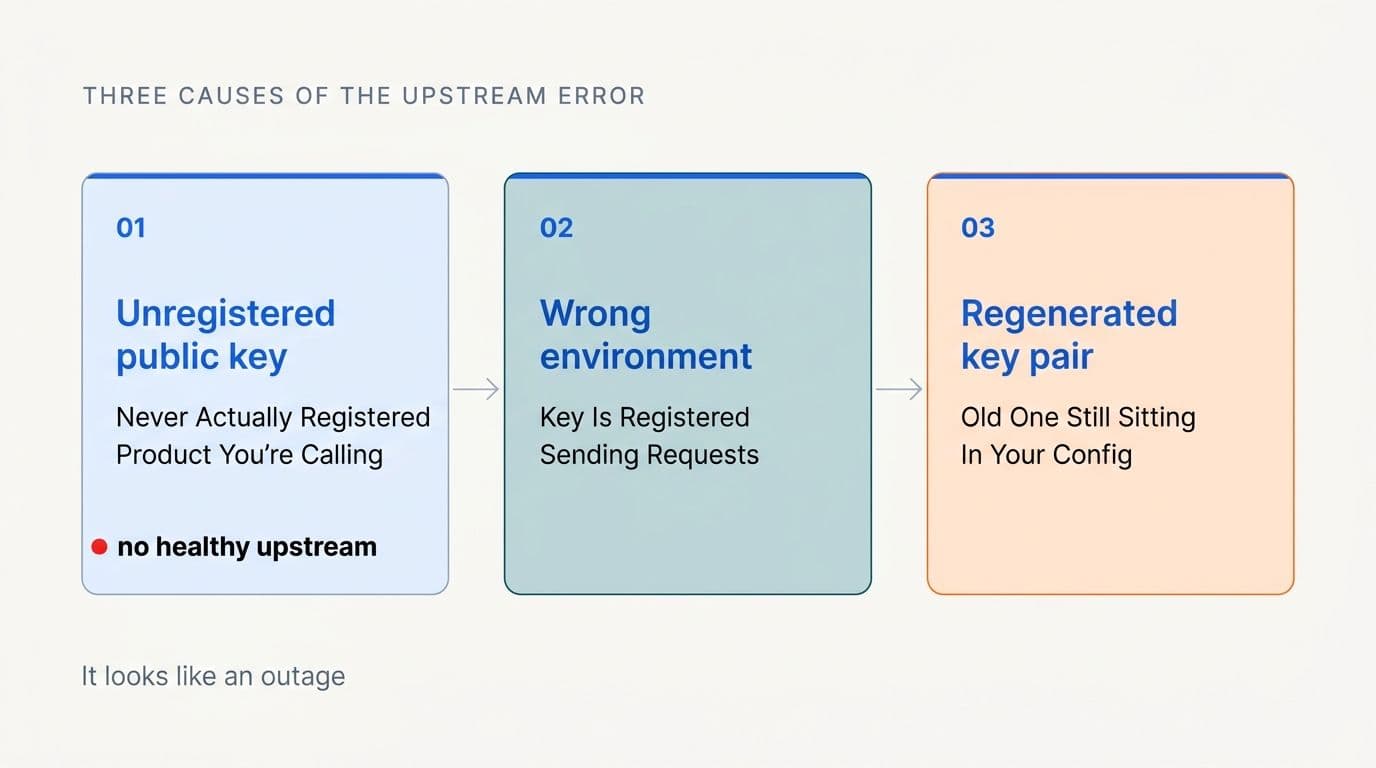
That message comes from the API gateway's load balancer telling you it has no backend to route your call to. In practice it means the gateway rejected your request before it ever reached a service. The three causes we see over and over are these: the public key you generated was never actually registered against the product you're calling, the key is registered but you're sending requests to the wrong environment, or the key pair was regenerated and the old one is still sitting in your config.
Work through it in that order. Confirm the public key shows as registered and active in your developer account, not just generated. A generated key that was never associated with a specific API product authenticates against nothing. The gateway returns the upstream error rather than a clean 401, which is why it reads like a server problem instead of a credentials problem.
Test server versus live server
This trips up more people than anything else in Walmart's stack. Keys are environment-scoped. A key provisioned for the sandbox will not work against production hosts, and a production key will not work against sandbox hosts. The symptom of a mismatch is identical to an unregistered key: no healthy upstream.
Decide explicitly which environment you are targeting before you write a line of client code, and store the base host in config rather than hardcoding it in two places that drift. When you promote from sandbox to production, swap both the host and the key together. Swapping one and not the other is the single most common cause of a working integration breaking on deploy.
Verifying credentials before you build
Do not debug authentication from inside your application. Make one bare request from the command line against the simplest endpoint the program exposes, then confirm you get a 200 with a body. Example, this is the shape of the check, not a Walmart-specific endpoint:

curl -i "https://example.com/health" \ -H "Authorization: Bearer YOUR_API_KEY"You should see a 200 status line and a short JSON body. If you get the upstream error here, the problem is the key or the host, and no amount of changing your HTTP client will fix it.
Two more habits worth building in: keep signature generation (Walmart's marketplace APIs require signed requests using your private key) in one tested module rather than scattered across services, and rotate keys on a schedule you control instead of waiting for a leak. Store the private key in a secrets manager, never in the repo. Log the key ID you used on every failed call so you can tell which credential broke.
Navigating Walmart's documentation without losing a day
Walmart's developer documentation is spread across several portals with overlapping names, and the structure does not map cleanly onto what you are trying to do. The affiliate program, the marketplace seller APIs, and the internal front-end endpoints are different worlds with different auth models, and the docs rarely say which one a given page belongs to.
A practical approach: identify which program owns the data you want before reading anything. If you need seller-side operations, you are in marketplace. If you need public catalog or suggestion data, you are either in affiliate or you are scraping. Then read only that program's auth page and its rate-limit page, and ignore the rest.
Expect gaps. Response schemas are often partially documented, error codes get one line of explanation, and sample payloads can lag the live service. Treat the docs as a starting hypothesis, and verify every field against a real response before you write parsing logic that assumes a field is always present.
Using a scraping API instead: the practical route to suggestion data
Because autocomplete has no supported public program, most teams building a walmart search suggestions api end up calling the public endpoint themselves. That works until it doesn't. The response is JavaScript-driven, the path changes without notice, and rate limiting kicks in once you move past hobby volume. Writing your own walmart autocomplete scraper means maintaining proxy rotation, header fingerprints, and retry logic forever.
This is where our Extract API fits. You point it at a URL, it handles rendering and blocking, and you get clean markdown or structured JSON back instead of raw HTML. The same pattern that works for a general ecommerce autocomplete api works here. Define the schema you want, let the extraction layer fill it, and skip CSS selectors that break on the next front-end deploy.
A few things that matter when you are running this at volume. Endpoint weights are visible before each run, so you know the credit cost of a call before you make it, and failed requests that return no data don't cost a credit. Top-up credits never expire. Every request scrapes live, there's no cached layer serving you last week's suggestions, which would defeat the point of tracking terms that move daily.
Worth being straight about the limits: we cover the scraping and SERP piece, not a full proxy and dataset product line. We're not SOC 2 Type II or ISO 27001 certified yet. Both are on the roadmap. Support is Slack-based, not a named CSM on a phone line. Scraping any site means reading that site's terms yourself, and we won't tell you it's always permitted.
Putting suggestion data to work
The pattern that pays off fastest: seed a prefix list from your category vocabulary, expand each prefix one character at a time, and store the full tree with timestamps. Re-run it weekly.
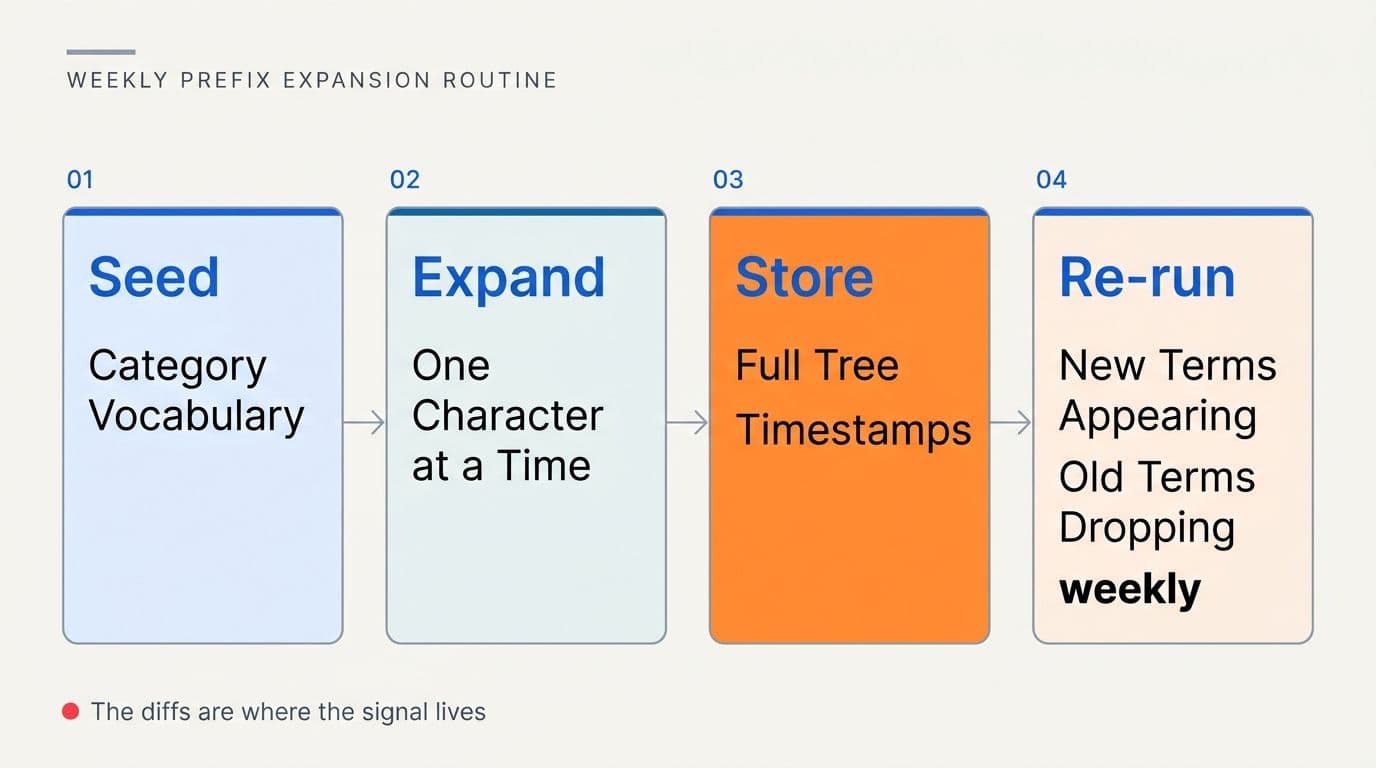
The diffs are where the signal lives: new terms appearing, old terms dropping, ordering shifts that precede a demand swing. From there, feed the terms into whichever catalog source you're using and join on product attributes. If you are doing the same work on Amazon, the mechanics are nearly identical. Our guide on how to scrape Amazon product data covers the catalog side in depth, and if sentiment matters more than keywords, scrape Amazon reviews walks through that extraction path. The full endpoint lineup lives on our API platform page.
One caution: do not treat suggestion volume as search volume. Autocomplete tells you a term exists and ranks it against its siblings. It does not tell you how multiple people typed it. Cross-check against a volume source before you brief anyone on demand.
Ready to pull structured suggestion data without maintaining a scraper? Get your API key, 1,000 one-time signup credits, no credit card. Or book a 30-min demo if you want to walk through the schema first.
Frequently Asked Questions
What causes the 'no healthy upstream' error when using Walmart's API?
The 'no healthy upstream' error comes from the API gateway's load balancer when it has no backend to route your call to, usually meaning the gateway rejected your request before it reached a service. The three main causes are: the public key was never actually registered against the API product you're calling, the key is registered but you're sending requests to the wrong environment, or the key pair was regenerated and the old one is still in your config.
How is Walmart autocomplete data personalized?
Walmart autocomplete suggestions are personalized at the edges through store location and session signals, which nudge the ordering so two machines in different states can see different lists for the same prefix. This means you need to control for location and treat the output as one sample of the ranking rather than assuming a single canonical list exists.
What is the difference between sandbox and production keys on Walmart's API?
Keys are environment-scoped, meaning a key provisioned for the sandbox will not work against production hosts, and a production key will not work against sandbox hosts. The symptom of a mismatch is identical to an unregistered key: the 'no healthy upstream' error.
What three properties of Walmart autocomplete data matter most?
First, the data is live and reflects current demand, so seasonal terms climb and fall within days. Second, it is prefix-driven and mines a trie of real queries rather than using semantic matching. Third, it is personalized at the edges based on store location and session signals.
How should you collect and use Walmart autocomplete suggestion data over time?
Seed a prefix list from your category vocabulary, expand each prefix one character at a time, and store the full tree with timestamps, re-running it weekly. The diffs are where the signal lives: new terms appearing, old terms dropping, and ordering shifts that precede demand swings.