


How to Scrape Amazon Best Sellers Rank: Tools Compared
By the end of this article you'll know where Amazon's Best Sellers Rank sits on a product page. You'll also know which of the three realistic approaches to scraping amazon best sellers rank fits your volume, and what it costs to run against 1,000+ ASINs. We'll also cover how to dodge the two failure modes that kill most of these projects. Those are brittle selectors and aggressive bot detection. We're a scraping API vendor, so we'll put our own option first and then be honest about where it doesn't fit.
This is a supporting piece to our main guide on how to scrape Amazon product data. Read that one for the general extraction pipeline, since this one is specifically about rank.
Step 1: Find where BSR actually lives on the page
BSR is not a single field. On most detail pages it sits inside the product details or additional information block, and it carries two or more values: an overall rank within a top-level department, plus one or more subcategory ranks that are usually far more meaningful for a seller. A product can sit deep in the hundreds of thousands overall and still rank top ten in a niche node. If your schema only captures the first number you find, your Amazon BSR tracking is measuring the wrong thing.

The same block is where the rest of the fields people want tend to live. That includes the bullet list Amazon labels "about this item," the brand and manufacturer rows, dimensions, the date first available, and the sold-by and ships-from values that identify the seller on the buy box. Treat all of these as one extraction job, not separate scrapers. You've already paid for the page load, so pull everything in a single pass.
Don't hardcode the department name. Amazon changes category labels and node structures, and a product can be re-categorized without any visible change to the listing. Store the rank value, the category string, and the timestamp together, and let your analysis layer resolve categories later. If you throw away the category name and keep only the number, every historical comparison you make after a re-categorization turns into garbage.
Step 2: Understand the terms-of-service and account risk first
This is the question most articles skip. Scraping public Amazon pages is not automatically legal or automatically a violation. It depends on the site's terms, how you access the data, your jurisdiction, and what you do with the output. Amazon's conditions of use restrict automated access, and we're not going to tell you that scraping is always fine regardless of those terms. Talk to counsel before you build a commercial product on top of it.
The practical risk is more specific than the legal one. If you scrape while authenticated, logged into a buyer account, or worse, a Seller Central account, you're tying automated traffic to an identity Amazon can act on. Keep rank collection entirely unauthenticated and distinct from any account you care about. Don't run your scraper from the same network as your seller operations, and don't scrape personal data about reviewers or sellers without a lawful basis to process it. The data protection picture varies by country and we can't promise blanket compliance in every jurisdiction.
Two legitimate alternatives are worth checking before you build anything. Amazon's SP-API gives sellers programmatic access to data about their own catalog, including sales rank, without any scraping. For competitor research specifically, Amazon's own AI-generated review summaries on top ASINs now cover a lot of the ground teams used to scrape reviews for.
Don't assume that because data is visible in a browser, the method of collecting it carries no risk. The method is what gets litigated and what gets blocked.
Step 3: Compare ways to scrape Amazon Best Sellers Rank (build vs buy)
There are three options, and the right one depends almost entirely on volume.
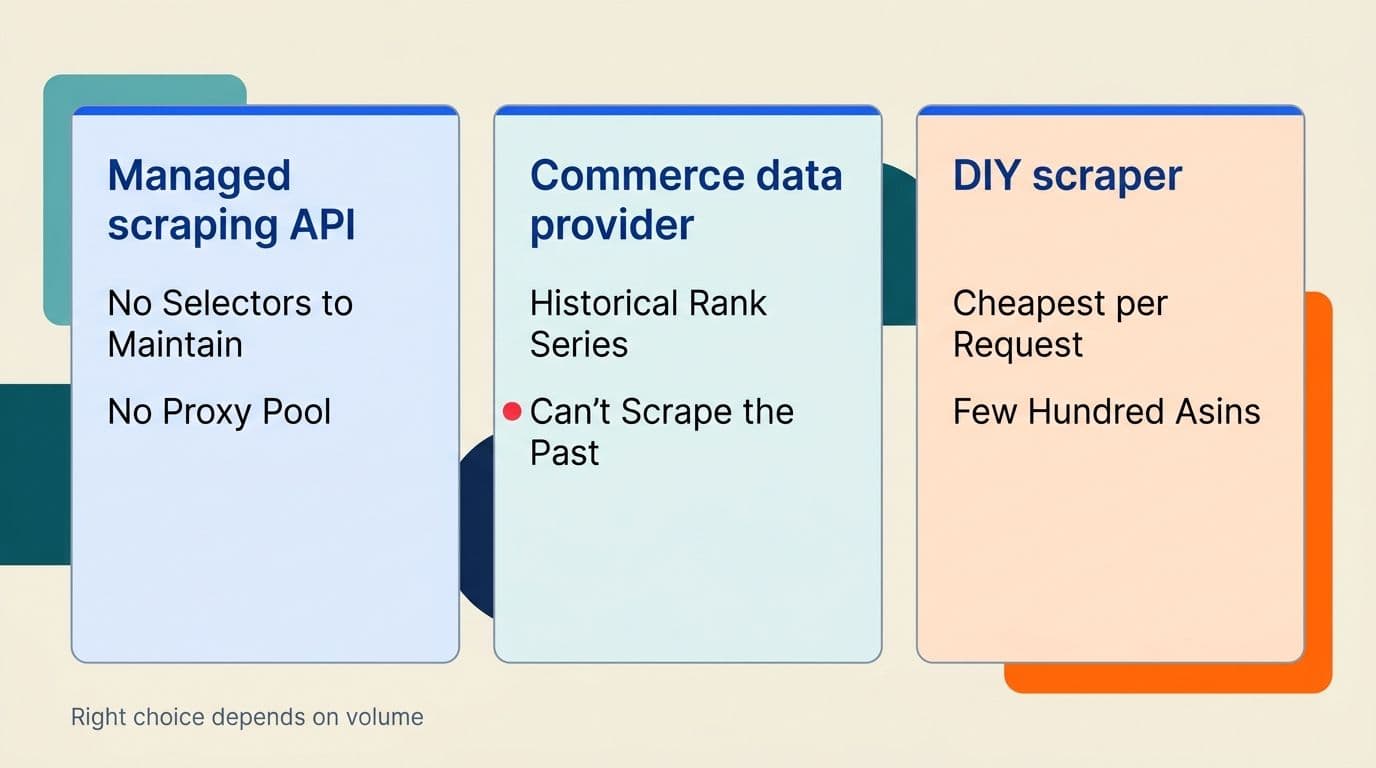
A managed scraping API. This is what we sell. You send a URL to our Extract API and get back clean markdown or structured JSON built to a schema you define. No selectors to maintain, no proxy pool, no headless browser fleet. Credit weights are visible per endpoint before each run, requests that return no data don't cost a credit, and top-up credits never expire. Plans start at $29/mo for 40,000 credits and go to $299/mo for 1,150,000, with 1,000 free signup credits and no card. Where we don't fit: we're the scraping and SERP piece, not a full proxy, unblocker, and pre-built dataset product line. We have Slack support with priority response, not a named CSM or 24/7 phone. SOC 2 Type II and ISO 27001 sit on the roadmap, not achieved yet.
A commerce-specific data provider. Services built around Amazon catalogs give you historical rank series out of the box, which you'd otherwise spend months accumulating. Buy it if you need five years of BSR history for an ASIN tomorrow, because you can't scrape the past.
A DIY Amazon sales rank scraper. Cheapest per request on paper, and genuinely workable for a few hundred ASINs checked daily from a handful of IPs. Before you build for 1,200 products, price the real thing: proxy spend, the engineer-hours spent on repair work every time layouts shift, and the compute for rendering. Compare that total against cost per lookup from an established API, not against raw request counts. Most teams who run that math honestly find the crossover arrives much earlier than they expected.
Don't count only bandwidth and server cost in the DIY column. Maintenance is the line item that actually decides it.
Step 4: Extract to a schema instead of CSS selectors
The single most common reason an Amazon rank tracking tool goes dark is that Amazon changed its page structure and nobody noticed for a week. Detail pages vary by category, by seller, by A+ content, by experiment bucket, and by locale. A selector that works on 95% of your ASINs will silently return null on the rest, and your dashboard will show a rank of zero rather than an error.
Define the fields you want: overall rank, category rank pairs, category names, the "about this item" bullets, price, seller name. Let a structured extraction step map the page to that shape, so when Amazon reshuffles the layout, a schema-based extractor usually still finds the values because it's working from meaning rather than DOM position. That's the core reason to scrape Amazon BSR data through an extraction API rather than a hand-rolled parser.
Validate on the way in. Rank should be a positive integer, category should be a non-empty string, and a missing value should raise rather than default. Then log null rates per field, per marketplace, per day. A jump in null rate for one field is how you detect a layout change before your customers do.
On rendering, don't put every request through a headless browser out of habit. Much of the product detail content arrives in the initial HTML, and rendering everything multiplies both your cost per lookup and your latency. Turn JS rendering on for the pages and marketplaces where you measure that it's needed, and leave it off elsewhere.
Don't treat an empty field as a zero. Nulls must stay nulls all the way to your database.
Step 5: Handle proxies, rate limits, and locale gaps at scale
Amazon applies rate limiting and bot detection far more aggressively than most other commerce platforms. If your mental model comes from scraping Shopify or eBay stores, recalibrate, since Amazon's defenses behave differently at every layer. Expect challenge pages, soft blocks that return a thin shell of HTML with no rank in it, and IP reputation effects that build over hours rather than appearing instantly.
If you're rolling your own, rotate residential IPs geographically matched to the marketplace. Keep per-IP request rates low and jittered, reuse sessions for short bursts rather than burning a fresh IP per request, and treat a thin page as a failure to retry rather than a success to store. Nobody, us included, can guarantee block-free scraping or CAPTCHA bypass in every case, so be wary of any vendor who says otherwise.
Locale is the other thing that quietly breaks datasets. Rank availability and category trees differ across amazon.com, .co.uk, .de, .in and the rest, and a field present in one marketplace may be absent in another. Our SERP coverage spans 100+ countries, which is not all 195+, so check your target marketplaces before you commit. Collect per-marketplace coverage metrics from day one rather than assuming parity.
Partial data is normal in some areas. Review extraction in particular tends to return a handful of reviews per product rather than the full set, because Amazon paginates and gates them behind interaction. We cover why and what to do about it in our piece on how to scrape Amazon reviews. Rank is simpler by comparison: it's one value on one page.
Don't retry a blocked request immediately. Back off, rotate, and cool down.
Step 6: Start with Best Sellers pages, then scale to full catalogs
Don't begin with 10,000 ASINs. Begin with the Best Sellers and Movers & Shakers listing pages for the categories you care about. Each one gives you roughly a hundred ranked ASINs in a single fetch, with rank position implied by the listing order. That's the cheapest possible way to monitor Amazon category rank and show a working dashboard in a day. Once that proves useful, expand to per-ASIN detail scraping for the products where you need subcategory rank and the surrounding fields.
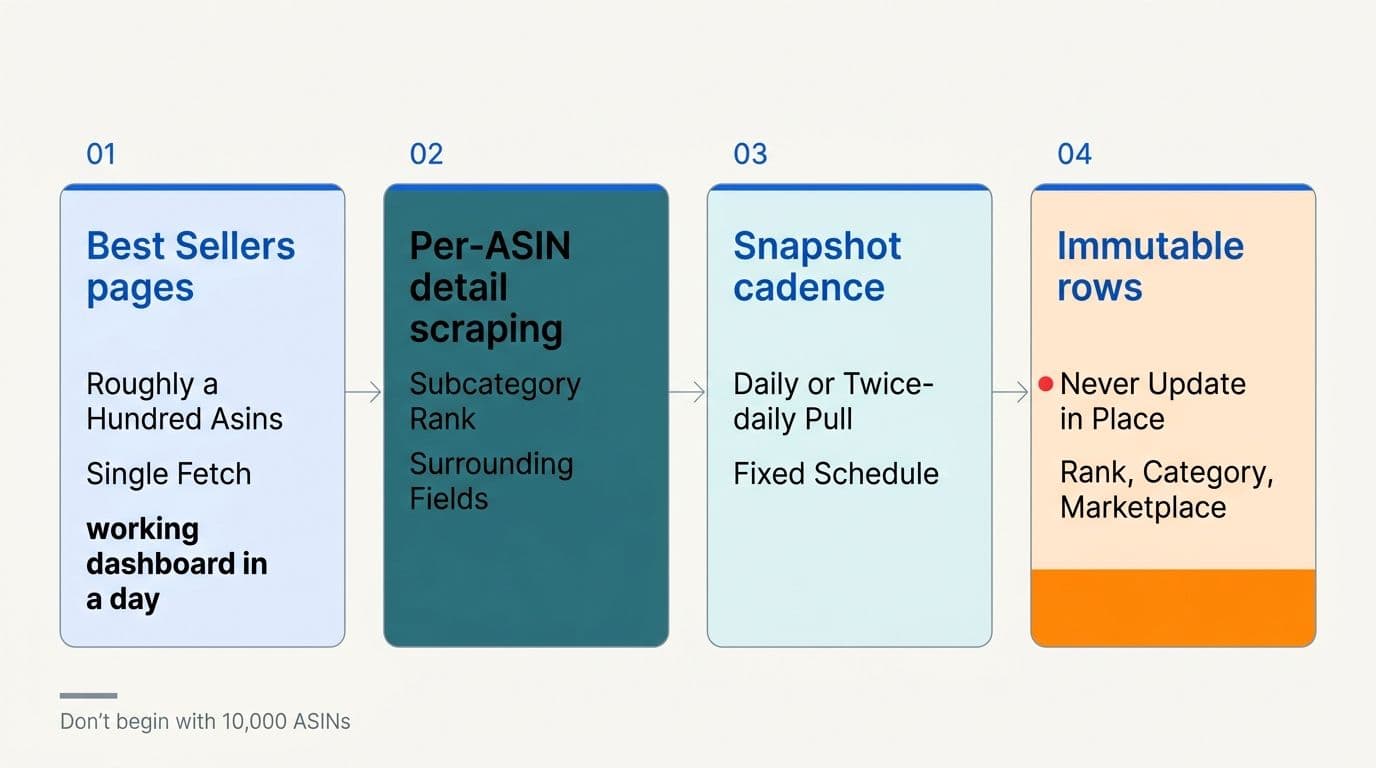
Snapshot cadence matters more than raw coverage. BSR updates frequently and is noisy intraday, so a consistent daily or twice-daily pull on a fixed schedule gives you cleaner trend lines than a dense but irregular one.
Write rank, category, marketplace, and timestamp as immutable rows, and never update in place, or you lose the history that makes an Amazon Best Sellers Rank API worth paying for in the first place. Migration from an existing vendor is real work, and output-format mapping is usually the bulk of it. Our response schema is Firecrawl-compatible, which shortens that path. Budget a day, not an hour, and run both pipelines in parallel until null rates match.
If you want to track Amazon product rank without owning a proxy fleet, start free with 1,000 credits and no card, read the docs, or book a 30-minute demo and we'll look at your ASIN list together.
Frequently Asked Questions
Where is Amazon Best Sellers Rank located on a product page?
BSR sits inside the product details or additional information block on most detail pages. It carries two or more values: an overall rank within a top-level department, plus one or more subcategory ranks that are usually far more meaningful for sellers.
Is scraping Amazon legal?
Scraping public Amazon pages is not automatically legal or automatically a violation—it depends on the site's terms, how you access the data, your jurisdiction, and what you do with the output. Amazon's conditions of use restrict automated access, so you should talk to counsel before building a commercial product on top of it.
What are the three ways to scrape Amazon Best Sellers Rank?
The three options are a managed scraping API, a commerce-specific data provider, and a DIY Amazon sales rank scraper. The right one depends almost entirely on volume, and you should compare the total cost including maintenance and proxy spend rather than counting only bandwidth and server cost.
Why do Amazon rank tracking tools stop working?
The single most common reason is that Amazon changed its page structure and nobody noticed, because detail pages vary by category, seller, A+ content, experiment bucket, and locale. A selector that works on 95% of ASINs will silently return null on the rest rather than raising an error.
How should you start scraping Amazon Best Sellers Rank at scale?
Begin with Best Sellers and Movers & Shakers listing pages for the categories you care about, since each one gives you roughly a hundred ranked ASINs in a single fetch. Once that proves useful, expand to per-ASIN detail scraping for products where you need subcategory rank and surrounding fields.