

How Much Does Google Search API Cost in 2026?
If you're sizing a SERP data pipeline, you want a number before you want a feature list. So here it is up front. In 2026, the honest answer to how much does Google Search API cost is roughly $1.50 to $5 per 1,000 queries at the bare-bones end. It climbs to around $21 per 1,000 calls once you're pulling full page content for 20 results per query. A one-time pull of 10,000 Google search results can land near $1.50 on the cheapest providers, while monthly plans across the market tend to run from about $20 to $300 for serious volume. Pricing and performance don't always move together, so a higher sticker price is no guarantee of better results.
That spread is wide because providers aren't selling the same unit. Before you compare anything, read our guide on is there an api for google search, which covers the mechanics of what a SERP endpoint actually returns, then come back here for the money side.
What You're Actually Being Billed For
The single biggest source of budget surprises is unit semantics. One provider bills per SERP page, another per result returned, another per successful search, another in credits with per-endpoint multipliers you only see on the invoice. Map those definitions out on paper before you open a pricing page. Comparing two marketing pages that use the word "request" differently means you're comparing nothing at all.
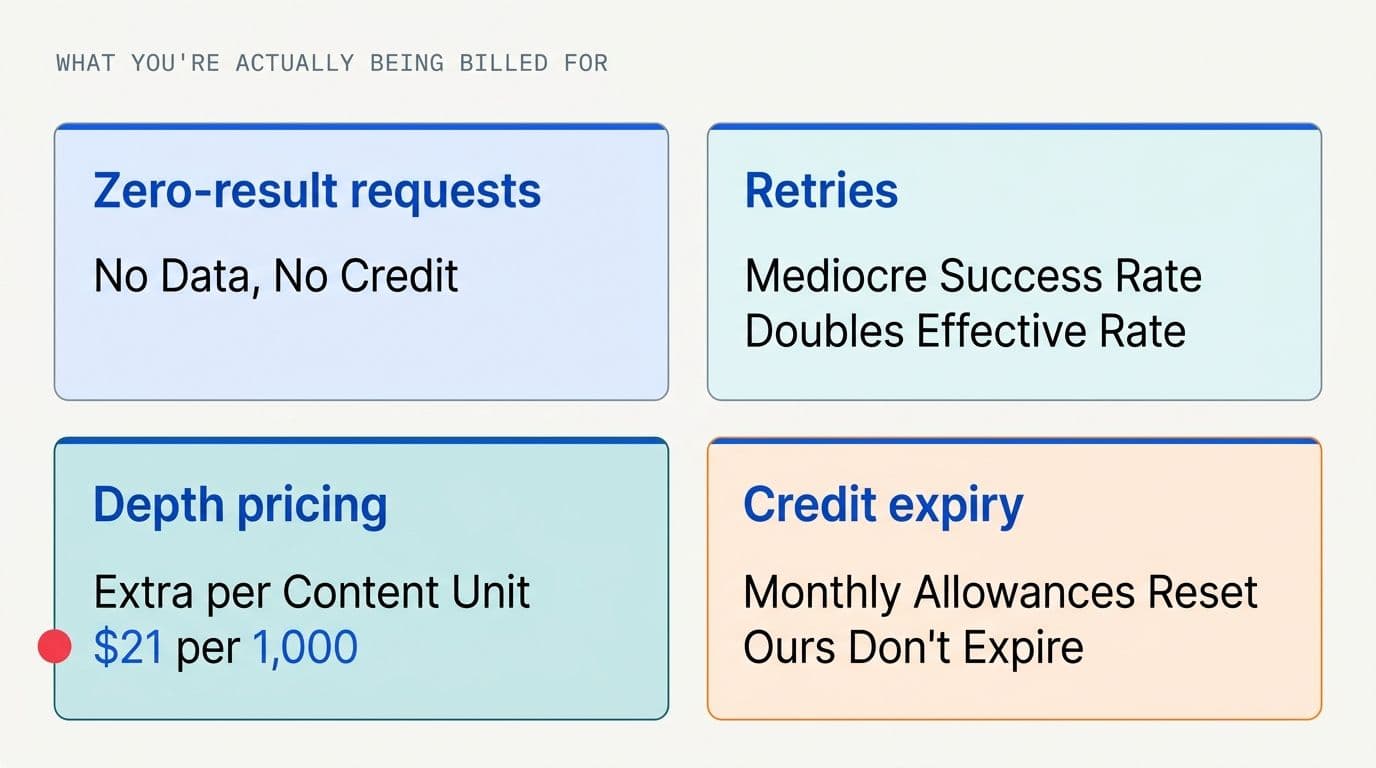
The questions that settle what you're actually being billed for:
- Does a request that returns zero results still bill? On many platforms it does. At DataBlue, failed requests that return no data don't cost a credit.
- Do retries bill? If a provider's success rate on a hard query class is mediocre, your retry logic quietly doubles the effective rate.
- Is depth priced separately? Most search APIs charge extra for each unit of content beyond the base result set. A query returning ten titles and snippets is cheap, while the same query returning twenty results with full page content runs multiple times the price. That's how $5 per 1,000 becomes $21 per 1,000 in production.
- Do credits expire? Monthly allowances usually reset. Whether purchased overage survives the period is a real cost factor for bursty workloads. Ours don't expire.
We publish endpoint weights before each run so you can see what a call costs you before you make it, rather than reverse-engineering it from a usage dashboard. The point isn't the specific weights. It's that a credit should mean the same thing on Monday that it meant on Friday.
Cost Per Usable Result Beats Cost Per Request
Cost per request is the number on the pricing page. Cost per usable result is the number that hits your P&L. They diverge fast.
A cheap endpoint that returns thin snippets often forces a second call. Maybe a scrape of the target URL, or a localized re-query because the first one came back with the wrong country's SERP. Two or three calls to get one answer makes a $1.50-per-1,000 provider more expensive than a $5-per-1,000 provider that resolves the query in one shot. When you benchmark at volume, instrument cost per usable result, not cost per call.
The harder metric, and the one almost nobody measures, is cost per resolved query. That means every downstream call, retry, parse, and model invocation needed to turn a raw SERP into a verified answer. For a RAG pipeline that means the search call, the fetches of the top N URLs, the tokens burned cleaning noisy HTML, and the re-runs when extraction fails schema validation. Teams consistently underestimate this because the search line item is the only one that arrives as an invoice. The rest shows up as cloud spend and engineering hours.
Model it explicitly. Take 1,000 representative queries from your actual workload, run them end to end, and divide total spend by the number of queries that produced a result you'd ship. Spend here includes API cost, egress, compute, and LLM tokens together, and that number is your real unit economics. It's also the number that makes LLM-ready output worth paying for: structured JSON or clean markdown cuts token count per document compared with raw HTML, and tokens are usually a bigger line than search calls once you're past prototype scale.
The Costs That Don't Appear on Any Pricing Page
Integration time. A provider with a well-documented, predictable schema can be wired into an existing pipeline in an afternoon. One with bespoke field names, inconsistent nesting, and selector-dependent output costs you a sprint of mapping work plus a permanent maintenance tax. Budget your own migration as engineering days, and price those days honestly.
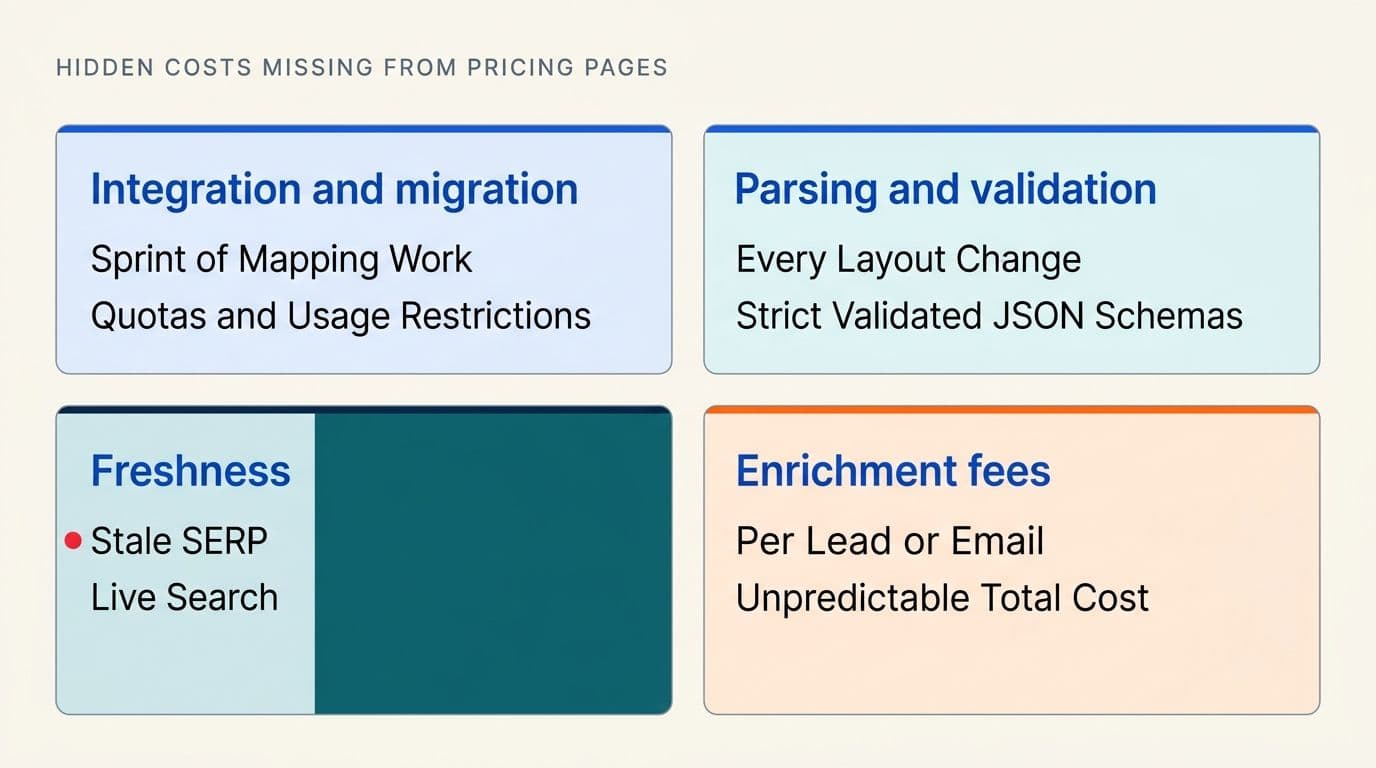
Parsing and validation. If you're writing CSS selectors against HTML, you're paying for every layout change Google ships. Strict, validated JSON schemas move that cost onto the vendor, and that's a real transfer of expense, not a nice-to-have.
Freshness. Cached results are cheap to serve and expensive to trust. For rank tracking, a stale SERP is a wrong answer you pay for twice: once to fetch, once to re-fetch when someone disputes it. Every DataBlue request is a live search.
Per-record enrichment fees. This bites hardest in lead workflows. Tools that charge per lead or per enriched email make total cost unpredictable the moment a list scales from hundreds to tens of thousands. Price enrichment on the same credit basis as everything else, or you can't forecast at all.
Migration off first-party search. Teams that built on Google's own programmable search path keep running into its quotas and usage restrictions. Plenty are moving to third-party SERP APIs for coverage and headroom instead. Plan that migration around output-format mapping and localization parity, including city, language, and device targeting, not just price per query.
Budget Modeling for Specialized Workloads
Generic per-query math breaks down on specialized use cases. Adverse media screening is the clearest example. Each subject name generates several query variants across languages and jurisdictions, and each variant returns results that must be fetched and read in full. Recall matters more than cost here, so you can't trim the result set.
Effective cost per subject can be an order of magnitude above cost per query. The same shape applies to competitive monitoring across hundreds of keyword-locale pairs, and to research agents that fan out from one user prompt into dozens of searches.
For these, model by business unit: cost per screened subject, cost per tracked keyword per day, cost per research task. Set a hard ceiling on fan-out in code. Also benchmark quality against data you already own by running queries where you know the correct answer and scoring providers on how often they return it. If accuracy is weak, you're buying cheap wrong answers at impressive scale, no matter how low the per-record price looks.
For small one-off pulls, don't buy anything yet. Free signup credits frequently cover an entire project. We give 1,000 one-time credits at signup, no credit card.
So How Much Does Google Search API Cost for Your Project?
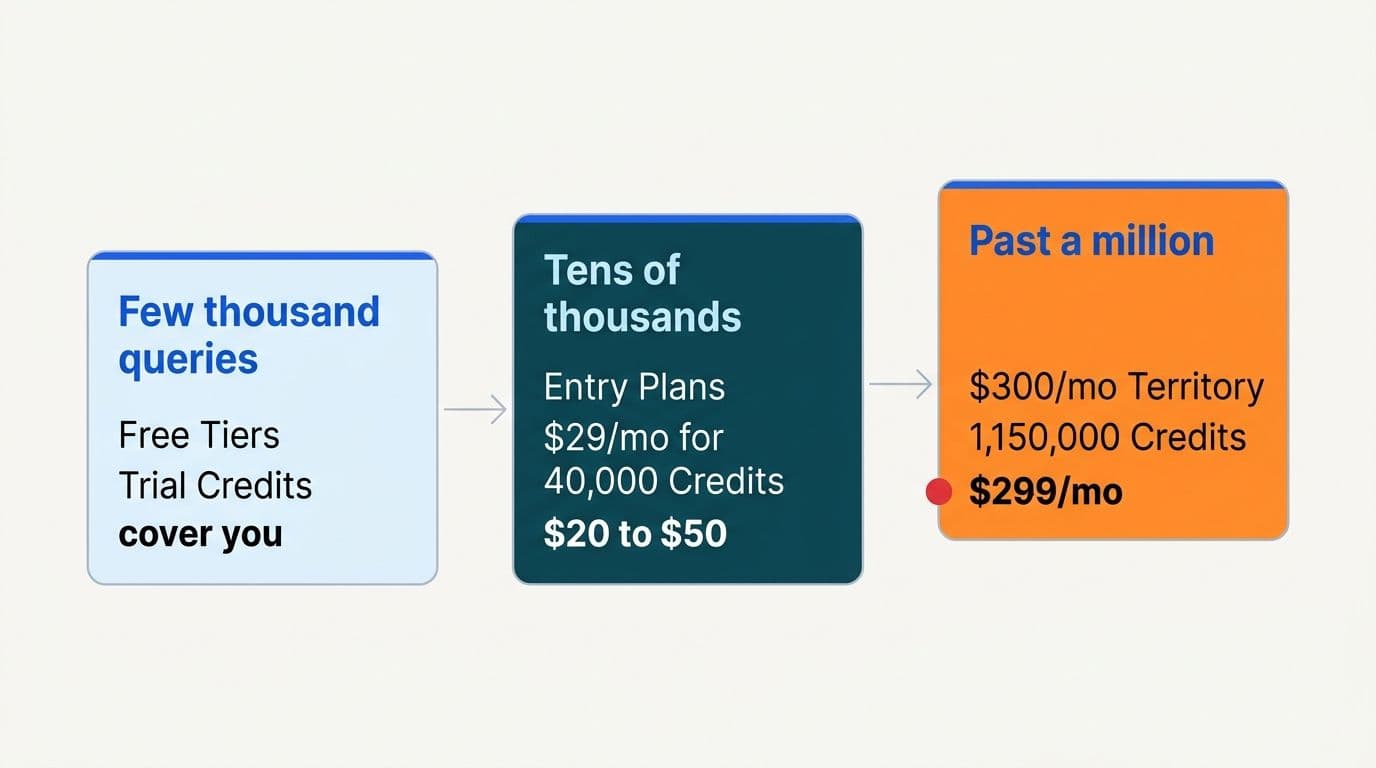
Work it from volume. Under roughly a few thousand queries a month, free tiers and trial credits will likely cover you. In the tens of thousands, entry plans in the $20 to $50 range are standard, and ours starts at $29/mo for 40,000 credits. Past a million queries a month, you're in the $300/mo territory. Our top plan is $299/mo for 1,150,000 credits, and the full breakdown lives on the Google SERP API page.
If you're already with a vendor and trying to work out how much Google search API costs you're really carrying, our serp api alternative comparison lays out unit definitions side by side so you're comparing spend rather than marketing copy. We're not for everyone: there's no named CSM, support runs through Slack, and SOC 2 Type II and ISO 27001 are on the roadmap rather than in hand. We cover 100+ countries, not every micro-locale.
RankMax runs its rank-tracking layer on our SERP API. Run your own 1,000-query benchmark before you commit to anyone.
Start Free with 1,000 credits, See Pricing, or book a 30-min demo if you want help modeling your volume.