

Is Scraping Google Maps Legal? What Developers Need to Know
Build anything that touches local business data and you hit this question fast. A lead list, a competitor map, a review sentiment model, a store locator. You will run into it within about an hour of starting. So let's answer it directly, then work through every sub-question that actually matters when you ship.
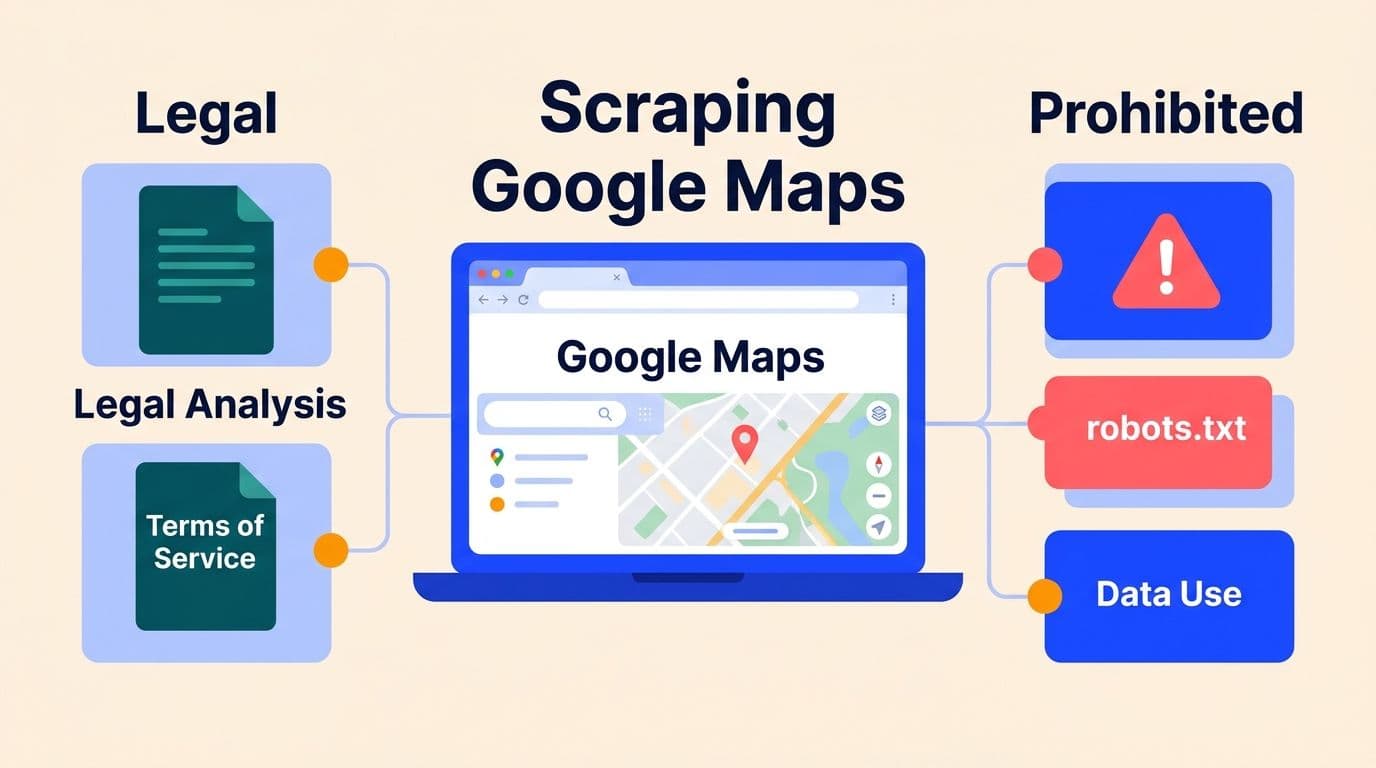
The question of whether scraping Google Maps is legal is the wrong shape of question. There is no single statute that says scraping Google Maps is a crime, or that it's fine. What exists is a stack of separate legal theories. Contract, computer-access law, copyright and anti-circumvention, and data protection all apply differently. Your exposure under each one depends on what you collect, how you collect it, how much of it you take, and what you do with it afterward. Developers who get burned usually got burned on one specific layer while assuming the whole question was settled.
This is not legal advice. It is a practitioner's map of where the risk actually sits, written in November 2026, after a year in which Google moved aggressively in court against scraping operations and quietly rewrote the terms everyone had been casually ignoring.
The short answer: is scraping google maps legal?
Collecting information that Google Maps displays publicly, business names, addresses, categories, phone numbers, hours, coordinates, star ratings, is not inherently illegal in the United States or the EU. There is no general prohibition on reading a public web page with a program instead of a browser.
What changes the answer is everything around the data:
- How you got in. If you logged in, used someone else's credentials, defeated a technical access control, or kept hammering an endpoint after Google explicitly cut you off, you have moved from "reading a public page" toward computer-access and anti-circumvention territory.
- What you took. Factual listing data (an address, a phone number) has thin copyright protection. Review text written by a human does not. Google's own compiled database and its presentation layer sit somewhere in between and are exactly what current litigation is about.
- How much you took. Volume is not a legal element in most statutes, but it is the single best predictor of whether anyone sues you. More on that below.
- Whose data it is. Reviewer names, profile photos, and review histories are personal data under GDPR and similar laws. Business addresses often are too, when the business is a sole proprietor working from home.
So the answer to the question of google maps scraping legality is this. It's usually a civil contract problem, occasionally a copyright problem, rarely a criminal problem. And it's always a data-protection problem the moment personal data enters your pipeline.
Terms of service are a contract, not a criminal statute
The clause everyone cites lives in Google's Terms of Service, which prohibits automated access to its services except through supported interfaces. Google updated those terms in June 2026. The changes are relevant enough to scraping that you should read the current version rather than a blog summary from a previous year, including ours. Anything written about google maps terms of service scraping restrictions before that update describes a document that no longer exists.
Here is what matters structurally: terms of service are a contract. Breaking a contract is a civil matter between you and the counterparty. The realistic remedies are account termination, API key revocation, a cease-and-desist, an injunction, and, if Google can show it, damages. That is a very different risk profile from a criminal statute, and it is the distinction most "scraping is illegal!" takes miss entirely.
There is a further wrinkle: whether you are bound at all. Clickwrap agreements, the kind where you created an account and checked a box, bind you clearly. Browsewrap, where terms sit behind a footer link on a page you never signed into, is enforced much less consistently. If your scraper never authenticates, never creates an account, and never accepts anything, the contract argument against you is weaker. "Weaker" is not "absent," though, and Google's updated terms were drafted by people who know this.
Treat that contractual language as a real constraint with real consequences for your accounts, not as a hypothetical.
CFAA web scraping: what the law actually criminalizes
The Computer Fraud and Abuse Act is the statute people invoke when they want scraping to sound criminal. It is also the one where the law has moved most clearly in scrapers' favor over the past several years.
Two developments drive current legal analysis in this area. First, the Supreme Court narrowed the "exceeds authorized access" prong. It held that the phrase covers obtaining information from areas of a system you are not entitled to access at all, not misusing information you were entitled to see. Second, the Ninth Circuit held that scraping data from a public profile that requires no login does not count as access "without authorization." There is no authorization gate to clear in the first place.
What that means in practice: if a Google Maps listing renders for an anonymous browser with no account, a CFAA web scraping claim against you for collecting it is a hard case for a plaintiff to make. The gate matters more than the volume.
What still creates exposure under this statute:
- Scraping behind a login, including logged-in-only features, personalization, or anything that required credentials.
- Continuing after a specific, targeted technical block or a cease-and-desist naming you. Courts have treated that as revoking authorization.
- Using credentials that are not yours, including a borrowed account or a purchased session.
- Defeating an access control that was clearly built to keep programs out, which drags CFAA web scraping liability toward the anti-circumvention claims in the next section.
The practical rule we follow and recommend: if a human with no account cannot see it, do not have a machine take it.
Copyright, DMCA, and the anti-circumvention front
This is where 2026 got interesting, and where most older articles on web scraping legal issues are now out of date.
Google has filed multiple suits against scraping services. The notable move is that the claims are not just contract and CFAA. They include copyright and DMCA anti-circumvention theories. The argument is that the technical measures protecting search and Maps results are access controls under the DMCA, and that routing around them is unlawful circumvention regardless of whether the underlying facts are copyrightable.
That theory is genuinely unsettled. Courts are actively examining whether collecting search results counts as illegal circumvention, and the reasoning cuts both ways. Facts are not copyrightable, but a compiled, arranged, rendered results page involves selection and presentation choices that might be. Google did not win every round, and some procedural setbacks against scraping-adjacent vendors have shown up along the way, which tells you the courts are not treating this as obvious in either direction.
For you, the takeaways are concrete. Review text is the riskiest payload in all of Google Maps: it is human-authored expressive content with a real copyright owner who is not you and not Google. Storing a few reviews for sentiment scoring is a different animal from republishing full review corpora on your own site. And if your scraping approach depends on defeating a protection mechanism rather than simply requesting a public page politely, you have taken on an anti-circumvention argument that did not exist five years ago.
These are the web scraping legal issues worth watching through 2027.
Is robots.txt compliance a legal requirement or a voluntary convention?
Short answer: robots.txt is a voluntary convention, not a statute. No US or EU law says you must obey the Robots Exclusion Protocol. It is a standard for cooperative crawlers, published as an informational RFC, and nothing in it carries independent legal force.

The long answer is why practitioners still treat it as near-mandatory. Robots.txt matters legally as evidence, not as a rule. When a plaintiff needs to show that access was unauthorized, or that your conduct was willful rather than inadvertent, a documented disallow directive that you parsed and then ignored is excellent material for them. It converts "we read a public page" into "we were told not to and did it anyway." That framing is corrosive in front of a judge who is not a developer.
The inverse is also useful: if a path is explicitly allowed in robots.txt, you have a reasonable argument that the operator invited automated access to it. Not a complete defense, but a real one.
Our practical position for google maps data extraction compliance: fetch and respect robots.txt as a default, log the version you fetched with a timestamp. If a business reason requires deviating from it, record who approved that decision and why. That log costs you nothing and is the cheapest possible insurance. Treating robots.txt as optional because it is not binding is technically correct and strategically foolish, the same way jaywalking is a minor offense until it is the fact that makes you look reckless.
Public visibility vs. digital trespassing
The hardest conceptual line in scraping public data legality is this: when does reading something that anyone can see become trespassing on someone's system?
Courts have mostly landed on access controls as the dividing line. Public page, no login, no technical barrier, you are reading, and that is not trespass. Login wall, rate limit you bypassed, IP block you evaded, token you forged, now you are circumventing a barrier the owner erected, and trespass-to-chattels and CFAA theories become live.
Trespass to chattels adds a second dimension that developers underestimate: harm to the system itself. The classic formulation requires actual impairment, measurable load, degraded service, real cost imposed on the operator. A scraper pulling listings at human-ish pace from a handful of IPs does not impair Google's infrastructure in any meaningful sense. A scraper running thousands of concurrent requests from a rotating pool, around the clock, is a different factual story, and a plaintiff will tell it with your own request logs.
This is the practical framing for scraping public data legality. Visibility establishes that the information is not secret. It does not establish that unlimited automated retrieval is permitted. The two questions are distinct, and arguing the first one louder does not answer the second.
Design accordingly. Keep concurrency reasonable. Back off on errors instead of retrying harder. Do not treat an HTTP 429 as a challenge. You want your traffic pattern to look like a well-behaved client, not because politeness is a defense, but because impairment is an element.
How much volume actually triggers legal action
Nobody publishes a threshold, and there isn't one in any statute. But the pattern in the current wave of litigation is straightforward enough to plan around. Google is suing operations that collect search and Maps results at industrial scale, not hobbyists, not a startup pulling a few thousand listings for a market map.
What moves you into the visible tier is some combination of:
- Sustained, continuous volume rather than a one-time collection project. A scraper that runs forever is a line item on someone's infrastructure cost report.
- Commercial resale of the data itself. Selling access to a Google-derived dataset puts you in direct competition with Google's own products, which is the fastest way to become a defendant.
- Public marketing. If your landing page advertises what you scrape and how much, you have handed opposing counsel their exhibit list.
- Evasion as a product feature. Marketing the ability to get around protections is materially different from marketing a data pipeline.
That asymmetry is uncomfortable but worth stating plainly. The google maps scraping legality question has a legal answer and an enforcement answer, and they are not the same answer. Build on the legal one, plan for the enforcement one.
The double standard: Google scrapes the web, then sues scrapers
Let's name the thing every developer notices. Google's entire business is built on crawling other people's websites, copying their content into an index, and displaying extracts of it, often enough that users never visit the source. Then it sues people who do a structurally similar thing to Google's own output.

No, that double standard is not a defense you can raise in court. Understanding why is more valuable than being annoyed about it.
Google's position on its own data runs the other direction. It provides official APIs, those APIs have terms and metered pricing, and it argues that taking the same data outside that channel is both a contract breach and a circumvention of a controlled access path.
What the double standard actually gives you is strategic information. Google's legal theory depends on its protection mechanisms counting as access controls. That theory is being tested right now, and until it resolves, the cautious posture is to build pipelines that do not depend on the outcome.
Personal data, reviews, and privacy law
Here is the layer that catches teams who cleared every other hurdle. In the EU and UK, GDPR applies to personal data regardless of whether that data was publicly visible. "It was on a public page" is not a lawful basis for processing. You need an actual basis, typically legitimate interests, plus a legitimate interests assessment, a retention policy, and the ability to honor access and deletion requests.
For Google Maps specifically, the personal data is obvious once you look. Reviewer display names, profile photos, review histories, and local guide badges are all tied to identifiable individuals. Business records look safer until you notice how numerous listings are sole traders using a home address and a personal mobile number.
The practical pattern we recommend for google maps data extraction compliance:
- Strip reviewer identity at ingestion if your use case is aggregate sentiment. You almost never need the name to score the text.
- Keep business firmographic fields and drop everything that identifies a natural person unless you have a documented basis for keeping it.
- Set a retention window and actually enforce it with a scheduled job, not a policy document.
- Record where each field came from and when, so a deletion request is a query rather than an archaeology project.
Many jurisdictions add rules on top, like CCPA/CPRA for California residents or Brazil's LGPD. We are not going to promise you compliance with every jurisdiction's data protection law. Nobody honestly can. What we can say is that the teams who run into trouble are almost always the ones who stored reviewer identities they never needed.
The surprise bill: unauthorized API usage on your own Google account
This one is not a courtroom risk, and it hits more developers than any lawsuit does. A recurring pattern we see: teams get unexpectedly large Google Cloud bills because a scraping tool, SDK, or someone's local script authenticated against their Google account, burning through metered Places or Geocoding calls that nobody budgeted for.
The mechanics are mundane. A convenience wrapper picks up ambient application-default credentials. A shared service-account key ends up in a repo and then in a CI job that retries aggressively. A "free" scraping tool asks for OAuth access, and the quota it consumes is yours. Billing alerts are configured at a threshold that assumed a prototype, not a production loop. By the time the alert fires, the charge has already accrued.
Hardening this is straightforward and takes an afternoon:
- Issue a dedicated project and service account per workload. Never let a scraping experiment run under credentials that also have production billing attached.
- Set hard quota caps on every metered Google API, not just budget alerts. Alerts notify you after the money is spent. Quotas stop it.
- Scope API keys by referrer or IP, and rotate them on a schedule.
- Audit which third-party tools hold OAuth grants on your Google account, and revoke anything you do not actively recognize.
- Check the billing export for calls you did not make, by API and by key.
A legal review that ignores the billing surface is incomplete. The most common actual cost of a Maps data project is not a lawsuit. It is an invoice.
Regional differences in enforcement outside the US and EU
Most writing on web scraping legal issues assumes US case law and GDPR apply everywhere, which covers maybe a third of where our readers operate. Enforcement posture, procedural norms, and the practical odds of a complaint ever reaching a courtroom vary enormously by country, even when the underlying statutes look similar on paper.

Company incorporation, server location, and data subject residency are frequently in three different countries, and nobody notices until a complaint arrives.
Build vs. buy: dedicated scrapers, enrichment tools, and multi-source stacks
Once the legal picture is clear, the next decision is architectural. There are three real options.
Roll your own scraper. Maximum control, maximum maintenance. You own proxy rotation, headless browser orchestration, CAPTCHA handling, selector churn every time a layout ships, and the full compliance record.
Use the sanctioned API. Clean contractually, predictable technically, constrained in coverage and field availability, and metered in a way that gets expensive at volume. The field and caching restrictions in the terms are the part teams underestimate. We walk through where those bind and what the realistic substitutes are in our Google Places API alternative comparison.
Use a structured data API. You trade some control for someone else maintaining the extraction layer, and you get structured JSON instead of HTML you have to parse. This is what our Map API does: live requests, no stale cache, output shaped for a database or an LLM pipeline rather than a DOM tree.
A fourth pattern is worth naming. Enrichment tools that resolve a company URL into firmographic fields are a different product from a Maps scraper. Teams often need both, Maps for location and review signal, enrichment for company context.
If you want the end-to-end mechanics, our guide on how to extract location data from Google Maps covers the pipeline from request to schema.
A practical google maps data extraction compliance checklist
Run this before the first production job, not after the first complaint.
Scope. Write down the specific fields you need and why. If a field has no downstream consumer, do not collect it. This single step eliminates most privacy exposure, because the fields teams over-collect are almost always reviewer identities.
Access path. Confirm every URL you touch renders without authentication. No login, no session token, no personalization. If anything in the pipeline authenticates, stop and re-examine it. That is the line where CFAA web scraping arguments get traction.
Volume and pacing. Cap concurrency. Implement exponential backoff on every error class. Never retry into a block. Keep per-day volume proportionate to an actual business need you can articulate.
Robots and terms. Fetch robots.txt, log it with a timestamp, and honor it by default. Read the current Terms of Service, which changed in June 2026, and record the date you reviewed them.
Data handling. Strip personal fields at ingestion, set and enforce a retention window, and build a deletion path before you need it. Document your lawful basis if you operate in or serve the EU or UK.
Output use. Do not republish review text verbatim at scale. Derived signal, scores, aggregates, embeddings, is a materially different copyright posture than reproduction.
Jurisdiction. Note where your company, servers, and data subjects sit, and review when any of the three changes.
Review cadence. Revisit quarterly. The litigation landscape in this area moved substantially during 2026 and has not settled.
Where DataBlue fits, and where it doesn't
We run live scraping and search on every request, return LLM-ready markdown or structured JSON, and show endpoint weights before each run so you know the credit cost up front. Failed requests that return no data do not cost a credit, top-up credits never expire, and monthly credits reset each period. A growing base of developers has built on the platform, and RankMax runs its SEO rank-tracking layer on our Google SERP API.

Plans start at $29/mo for 40,000 credits and go to $299/mo for 1,150,000. Signup is self-serve, with 1,000 free one-time credits and no credit card.
Here are the limits of what this covers, since a compliance article should tell you where it stops helping.
Most importantly: using a vendor does not transfer your legal obligations. You still own the compliance decisions above. We handle the plumbing.
Start building
The honest summary on google maps scraping legality in late 2026 looks like this. Public listing data is defensible, review text is the risky payload, authentication is the bright line, volume drives enforcement, and the anti-circumvention theory is live and unresolved. Scope tightly, log everything, and do not build a pipeline whose viability depends on a case that has not been decided.
When you are ready to stop maintaining selectors: Get Your API Key with 1,000 free credits, Read the Docs, or Book a 30-min demo and we will walk through your specific use case.