


Local pack rank tracking means measuring where a business appears in the three-result map block for a given query, from a given point on the map, at a given moment. That last part is where most implementations break. The local pack is resolved per coordinate, not per city. A position is only meaningful when you store the latitude and longitude, the query, the device, and the timestamp alongside it. Build the schema that way first. Everything downstream, grids, trend lines, client reporting, stays honest.
How local pack rank tracking is actually measured
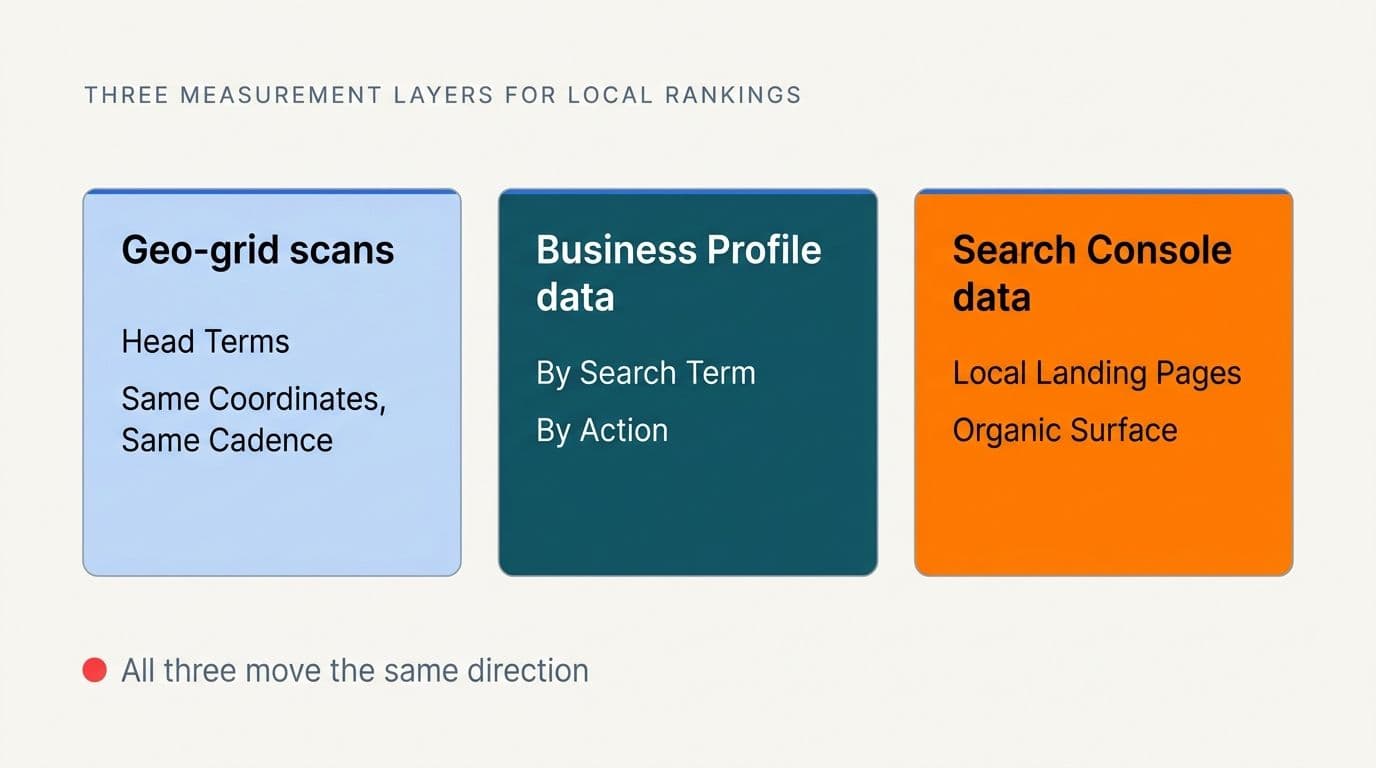
The approach that holds up in practice uses three layers. Fixed geo-grid scans for your head terms give you spatial coverage. Same coordinates, same cadence, every run, so movement is attributable to the business rather than a shifted sample. Google Business Profile performance data, broken out by search term and by action, tells you what people did after they saw the listing, and Search Console data for local landing pages covers the organic surface that sits underneath the map block. Treat a signal as real only when all three move the same direction. One layer moving alone is usually noise.
That is also why heat map scans deserve less trust than the pretty visuals suggest. Results shift constantly and are heavily personalized. A weekly or monthly sweep is a snapshot of one sampling pass, not what an average searcher sees. Geo-grid versus single-location methodology is a trade-off, not a verdict. Single-point checks are cheap and good for regression testing, while grids expose the radius at which you actually stop ranking. Run grids tight, and often enough that a single volatile day cannot define the trend. Smooth across runs before you report anything.
If you are pulling the underlying place data yourself, our guide on how to extract location data from Google Maps covers the extraction side of this pipeline.
Local pack rankings and organic rankings are two different problems
Most teams treat them as one problem. They are not. Map block movement comes from Google Business Profile optimization, review velocity, and proximity. Organic movement comes from content quality, internal linking, and backlinks. The activity sets barely overlap, which is why a quarter of link building can leave local pack rankings flat while a quarter of citation cleanup does nothing for the ten blue links. Alternating focus, profile and reviews one month, content and internal links the next, tends to produce better combined results than running both half-heartedly at once.
Backlinks still matter locally, just indirectly. Local links strengthen site-wide authority and reinforce the entity, which supports the whole footprint. They do not haul a listing from position eight to the top three on their own, so price your effort accordingly.
Outer ring problems need their own diagnostic. Before you chase grid cells at the edge, check whether competitors in that ring are physically nearer than you. Then check whether their review volume and recency outclass yours. Radius limits are category-specific: a service with wide intent travels further than a dense, high-competition retail category where proximity dominates. If closer competitors with stronger review signals own the outer cells, that ring is a budget sink. The honest answer to the client is that the ceiling is structural.
Review velocity across multiple locations is its own operational discipline. Track rate per location per month, not lifetime totals, and flag locations that go quiet. Inconsistent velocity across a portfolio is the most common reason one store's rankings decay while its neighbors hold.
Validating movement, AI surfaces, and building the tracker
Rankings are a proxy. Calls, direction requests, website clicks, and form leads, segmented by location, are the validation. If grid averages improve and those actions do not, something is wrong with your sampling or your terms. AI search engines complicate this validation further. Assistant answers increasingly displace the classic block, and they lean harder on classic SEO signals than on proximity math. Think authoritative content, consistent entity data across the web, and citations a model can verify. For AI visibility, feed the entity. For Maps, feed the profile. Monitor both surfaces separately or you will misread a drop.

To build this, you need live, coordinate-scoped results on every request rather than cached snapshots. Our Map API and Google SERP API return structured JSON localized by city, language, and device across 100+ countries.
Not every micro-locale is covered, so verify your markets before committing. RankMax runs its SEO rank-tracking layer on our Google SERP API. If you are weighing vendors, our Google Places API alternative comparison lays out the differences.
Endpoint weights are visible before each run. Failed requests that return no data cost nothing, and top-up credits never expire. Get Your API Key with 1,000 free signup credits, no card required.