


Every developer building an LLM app starts the same way. You pip install an open-source scraping library, grab a raw web page, run it through a basic html-to-markdown converter, and pipe the output straight into GPT-4o or Claude. The first response comes back coherent and genuinely impressive. It feels like magic.
Then you try to scale it.
At 10 pages a day, this pipeline is a demo that dazzles your team. At 10,000 pages a day, it's a liability. Your LLM bills balloon and your p95 latency climbs into the multi-second range. Your vector database quietly fills with garbage. Cookie consent banners, navigation menus, footer sitemaps, and base64-encoded SVGs that no human or model ever asked for.
The uncomfortable truth is this. Converting raw HTML to Markdown is a necessary first step, but it is not a production-ready solution for LLMs. True scale requires a shift away from unstructured Markdown dumps toward structured, token-optimized JSON payloads. The phrase "html to markdown for LLM" sounds like a solved problem. One library call, one clean string. It hides a massive engineering tax that only reveals itself under load.
This is where a purpose-built platform like firecrawl.dev enters the conversation as one option. DataBlue takes the idea further by handing you typed, structured data instead of a wall of text. Let's break down why the naive approach breaks. We'll cover what it actually costs you and what a production-grade web scraper for LLM workloads looks like.
The Anatomy of a Naive "HTML to Markdown" Pipeline
The standard hobbyist pipeline looks roughly like this. You fetch the page with requests or httpx, parse it with BeautifulSoup, strip the HTML tags, and emit Markdown. Ship it.
It works because Markdown is far more token-efficient than raw HTML. You're throwing away angle brackets, class attributes, and script tags. That's a real win over feeding raw <div> soup to a model.
But "less bad than raw HTML" is not the same as "good." Here's where the naive conversion quietly fails. Test your own pipeline against a busy page and count the junk.
Boilerplate Retention
A Markdown converter doesn't understand your page semantically. It just transforms tags. That means headers, cookie consent notices, and newsletter signup prompts all survive the trip. Your converter dutifully turns them into Markdown links and lists. Now they're indistinguishable from the actual content you cared about. Strip these before you ever hit the model.
Context Dilution
This is the killer for retrieval-augmented generation. LLMs are demonstrably worse at the "needle in a haystack" problem when the haystack is enormous. If your model has to wade through 20KB of navigation links and legal disclaimers to find one paragraph of substance, retrieval accuracy drops. Hallucination risk climbs.
You're paying premium token rates to actively degrade your own output quality. That's a poor trade at any volume. Cut the noise and watch accuracy recover.
Silent Data Loss
Here's the irony. While Markdown converters keep the junk, they also throw away the good stuff. Standard Markdown engines strip out structured metadata that LLMs need for accurate reasoning. schema.org JSON-LD blocks, author bylines, and canonical URLs vanish. The relational structure of complex tables goes too. A price or an event date encoded in microdata simply evaporates. You keep the cookie banner and lose the SKU.
That's the opposite of what a reasoning system needs. Structured facts are the whole point of scraping. Audit one page's output and check what survived.
The Hidden Token Tax
Let's talk numbers, because this is where the abstract problem becomes a line item on your invoice.
Consider a typical content-heavy web page run through three different processing strategies.
| Approach | Payload Size | Approx. LLM Tokens |
|---|---|---|
| Raw HTML (basic fetch) | ~214 KB | ~52,000 tokens |
| foundational Markdown conversion | ~60. 80 KB | ~15,000. 20,000 tokens |
| DataBlue structured JSON | ~14 KB | ~3,500 tokens |
Raw HTML is a non-starter. Nested <div>s, inline scripts, and class attributes push a single page past 50,000 tokens. Basic Markdown conversion helps, cutting you down to the 15,000 to 20,000 token range. But it still leaves you carrying three to five times more tokens than you need. The boilerplate is still in there.
A clean, structured payload lands around 3,500 tokens. That's an 80% reduction compared to the naive Markdown output. Run your own page through and measure the gap.
Why 80% Smaller Changes Your Business Model
That reduction is not a rounding error. It compounds across every dimension of a production system.
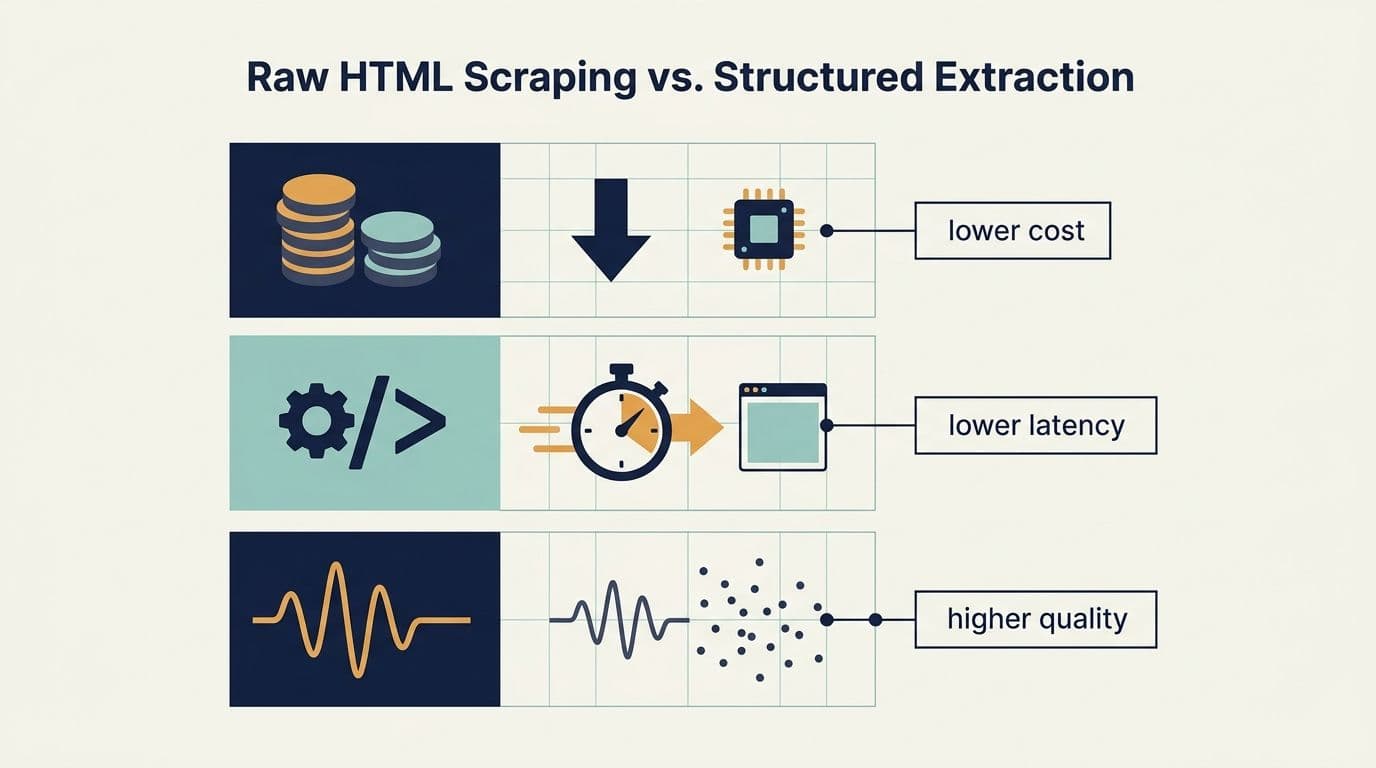
- Cost: Fewer input tokens means directly cheaper LLM calls. At scale, an 80% payload reduction translates to roughly 6x cheaper inference per page. Multiply that across 10,000 daily pages and you've moved from a burning cash pile to sustainable unit economics.
- Latency: Smaller context windows mean faster time-to-first-token. Inference speed is partly a function of how much the model has to read before it reasons.
- Quality: Less noise means the model spends its finite attention on signal, which measurably reduces RAG hallucinations.
Agentic workflows fire dozens of page fetches and model calls in sequence per request. This multiplier effect is the difference between a feature that scales and one that finance shuts down. If you're wiring search results into your model, the same optimization principle applies to the query side. Our guide on integrating Google Search with LLMs walks through how to keep the entire search-to-LLM pipeline lean. Start there if search is part of your stack.
Beyond Raw Markdown: Why LLMs Need Typed, Structured JSON
The deeper problem with Markdown strings is unpredictability. LLM agents require predictable inputs to produce predictable outputs. When your scraper emits an arbitrary Markdown blob, where the structure changes based on whatever the source site happened to render, your prompt parser has to work twice as hard to normalize it. You end up writing brittle post-processing regex to fish out the title and guess where the body starts. You hope the date wasn't stripped.
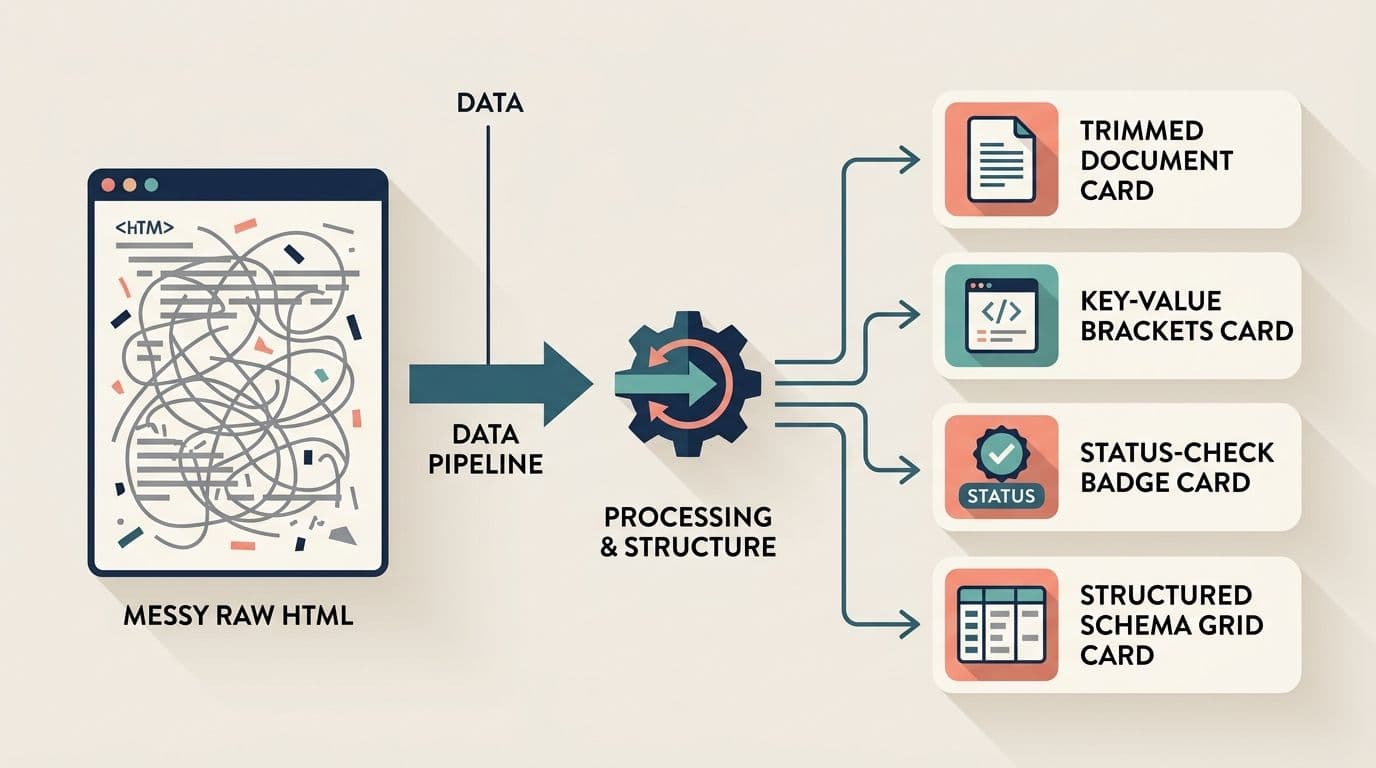
DataBlue's approach flips this. Instead of handing you a messy string, it returns a typed, 18-field JSON object built for machine consumption. Here's the anatomy of what actually matters for LLM workloads. Map these fields to your own types before you build.
markdown vs. fit_markdown
You get both the full Markdown rendering and a fit_markdown variant. That content is dynamically trimmed to fit strict LLM context windows without losing the core substance. The boilerplate is gone. The article body stays. This is the field you feed your model when tokens are precious, which at scale is always. Default to it and save the complete version for archival.
structured_data
Pre-extracted JSON-LD and microdata, parsed for you. E-commerce prices, review ratings, and product availability all arrive here as clean key-value data. This is the structured metadata that a naive Markdown converter throws in the trash.
You stop writing custom parsers for every target site's schema. Point your app at this field and drop the regex.
metadata
Title, SEO tags, HTTP status codes, and canonical URL, all pre-parsed. You know instantly whether a fetch succeeded and how substantial the page was. You also learn how to attribute it, without another round of string parsing. Read the status code first and branch your logic on it.
extract
This is the payoff for LLM builders. Schema-driven extraction right at the scraper level. You define a JSON schema for exactly the fields you want. The page is parsed straight into that shape. Instead of scrape, convert, prompt, parse, then validate, you collapse the middle steps. You get typed data back that matches your application's own types. Define your schema once and reuse it across every target.
The point isn't that Markdown is useless. It's that Markdown alone forces your application to reconstruct structure the scraper already knew about and then discarded. Typed JSON preserves that structure end to end. Reach for it whenever you build for machines.
## The Unseen Scaling Bottleneck: Infrastructure vs. Parsing
Even if you nail the parsing, there's a second war you're fighting at the same time. It's the one that quietly consumes your engineering weeks. Plan for it early.
The Two-Front War
Front one is the scraper problem. You manage rotating proxies, bypass Cloudflare and WAF challenges, render dynamic JavaScript for single-page apps, and handle rate limits without getting blocked. This front is getting harder, not easier. Site operators are actively deploying anti-crawler defenses like Anubis, a proof-of-work system that flips the CAPTCHA model. It makes crawling computationally expensive enough to deter large-scale bot farms. As The Register reported, the pressure from LLM crawlers has become so intense that operators are willing to burn visitor CPU cycles just to fend them off. Your naive scraper is walking into an increasingly hostile environment.
Front two is the extraction problem. You turn that hard-won HTML into clean, structured, LLM-ready tokens. That's everything we covered above. Treat both fronts as one system or lose to the harder one.
Why DIY Breaks Down
Here's the failure mode every team hits. You write a beautiful BeautifulSoup pipeline, tuned perfectly to a target site's class="article-body" selectors. It works flawlessly. Then, on a Tuesday, the target site ships a redesign, renames its CSS classes, and your extraction silently returns empty strings.
Your vector store starts filling with nulls and your RAG answers degrade. Nobody notices until a customer complains. Multiply this fragility across every site you scrape. You've built a full-time maintenance job disguised as a feature. Add schema monitoring now if you insist on the DIY route.
The DataBlue Solution
DataBlue handles the entire lifecycle. Proxy rotation, CAPTCHA and challenge handling, JavaScript rendering, and content cleaning. You deal with exactly one thing. A single, typed JSON API response. You stop babysitting BeautifulSoup pipelines. You stop firefighting proxy bans. The infrastructure war is fought on your behalf, and you consume the result. Hand it off and put those weeks back into your product.
Migrating from Firecrawl or Custom Pipelines in Minutes
If you're already running a scraping stack, the good news is that switching doesn't mean a rewrite.
DataBlue offers a drop-in compatible response shape for teams already building against firecrawl.dev or SerpAPI-style schemas. You don't need to refactor your application logic or rip out your existing prompt templates. You point your API requests at DataBlue. You immediately start receiving payloads that are up to 80% smaller and structurally cleaner than what your current pipeline produces.
For most teams, this is a ten-minute change. Swap the endpoint, update the API key, and confirm your existing parsers still line up against the compatible schema. The migration cost is near zero. The token savings start on the very next request. Point one endpoint at DataBlue today and compare payloads.
Good AI output is a direct function of clean input data. It doesn't matter how carefully you've tuned your prompts or which frontier model you're paying for. If you're feeding it 20,000 tokens of navigation menus and cookie banners, you're spending money to make your model slower and less accurate.
The move from raw HTML to Markdown was the right instinct. But stopping there leaves the hardest 80% of the problem unsolved. The boilerplate, the lost metadata, and the brittle infrastructure underneath it all. Production-grade LLM retrieval demands typed, structured, token-optimized payloads. Not unstructured blobs.
Stop wasting tokens, money, and your model's limited attention span on unoptimized conversions. If you're building deep research features or agentic web browsing at scale, explore DataBlue's Deep Research platform and start ingesting data your LLMs can actually reason over. Sign up, point your requests at DataBlue, and optimize your data ingestion today.