

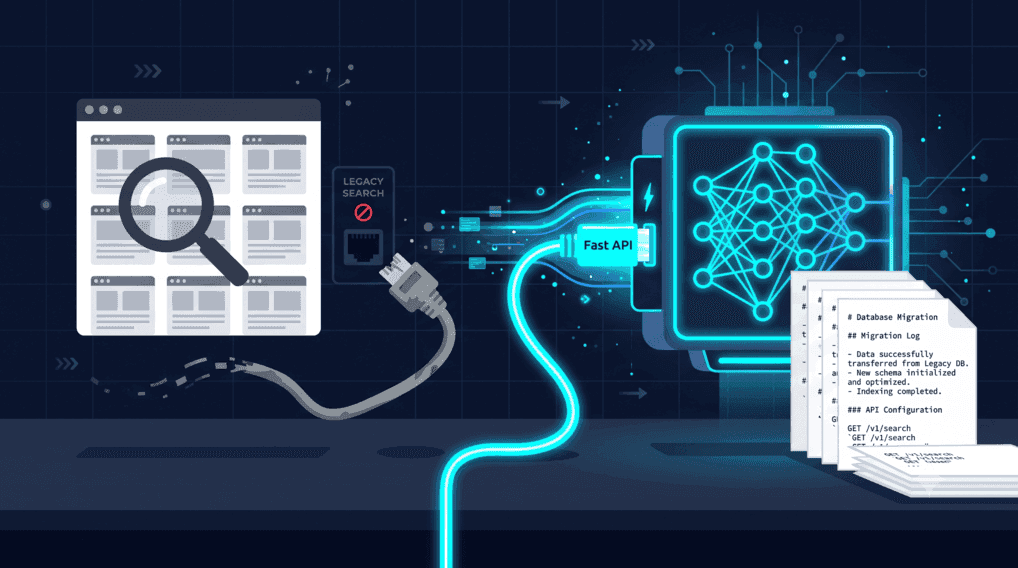
For over a decade, Google's Programmable Search Engine (formerly Google Custom Search) has been the default choice for developers. If you needed to bolt search onto an app without building a crawler from scratch, it worked. It was cheap and familiar. It returned results from the world's most authoritative index.
That era is quietly ending. Maybe you're a CTO, product manager, or AI engineer building on Google's legacy search APIs. You've probably noticed the writing on the wall. Rising friction and stagnant features point toward a push into heavyweight enterprise AI suites. If you're weighing a Google Custom Search alternative for a modern stack that feeds LLMs or powers AI agents, start planning your migration now.
This article breaks down why the landscape is shifting. It shows where the gaps are. Then it covers what a genuinely modern search API should deliver in 2026 and 2027.
The 2027 Horizon: Why Google Is Deprioritizing Legacy Search
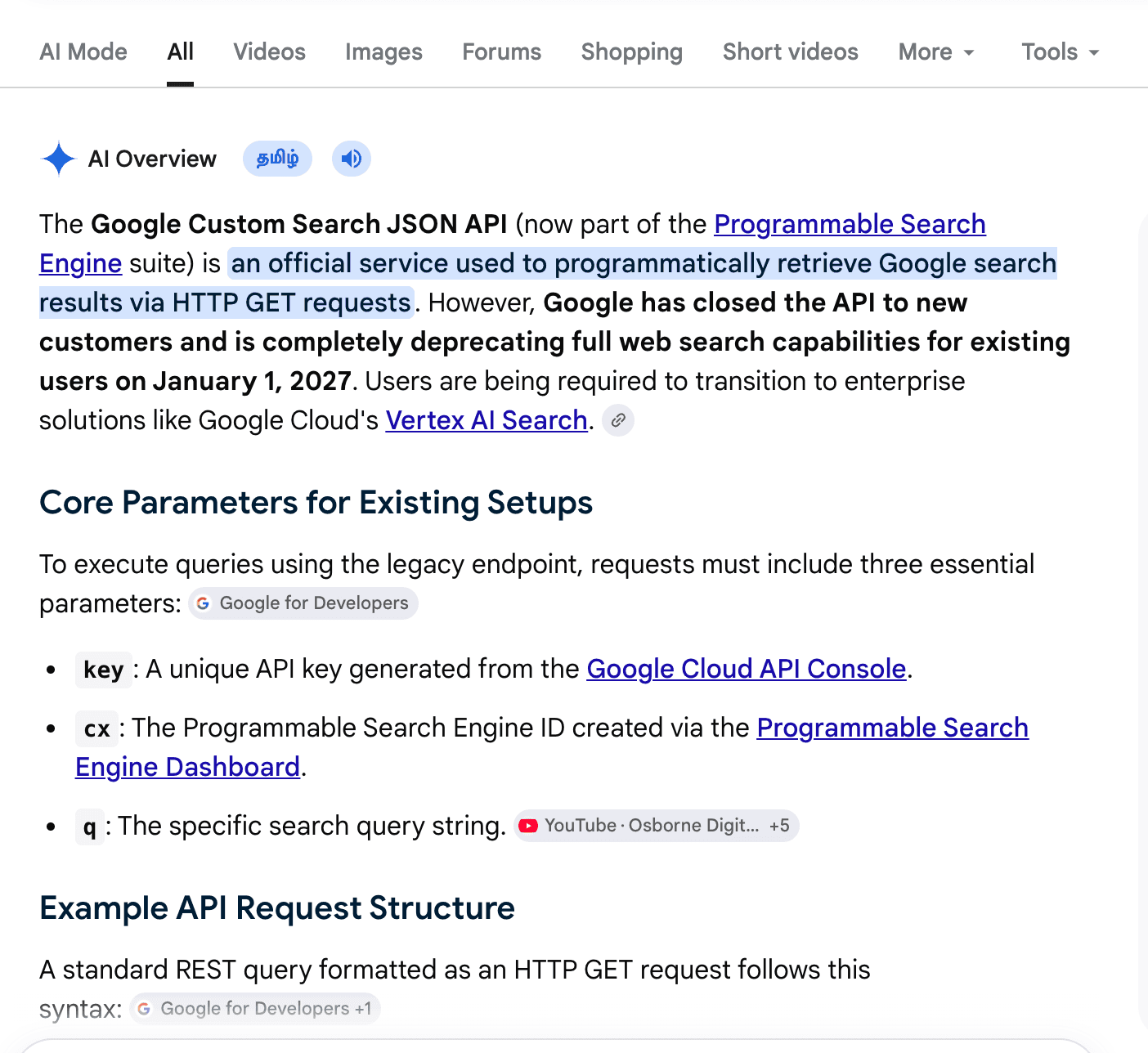
Google hasn't published a dramatic "shutdown" notice for the Custom Search JSON API. Instead, we're seeing something more insidious for developers who depend on it. Call it strategic neglect combined with a calculated funnel toward enterprise products.
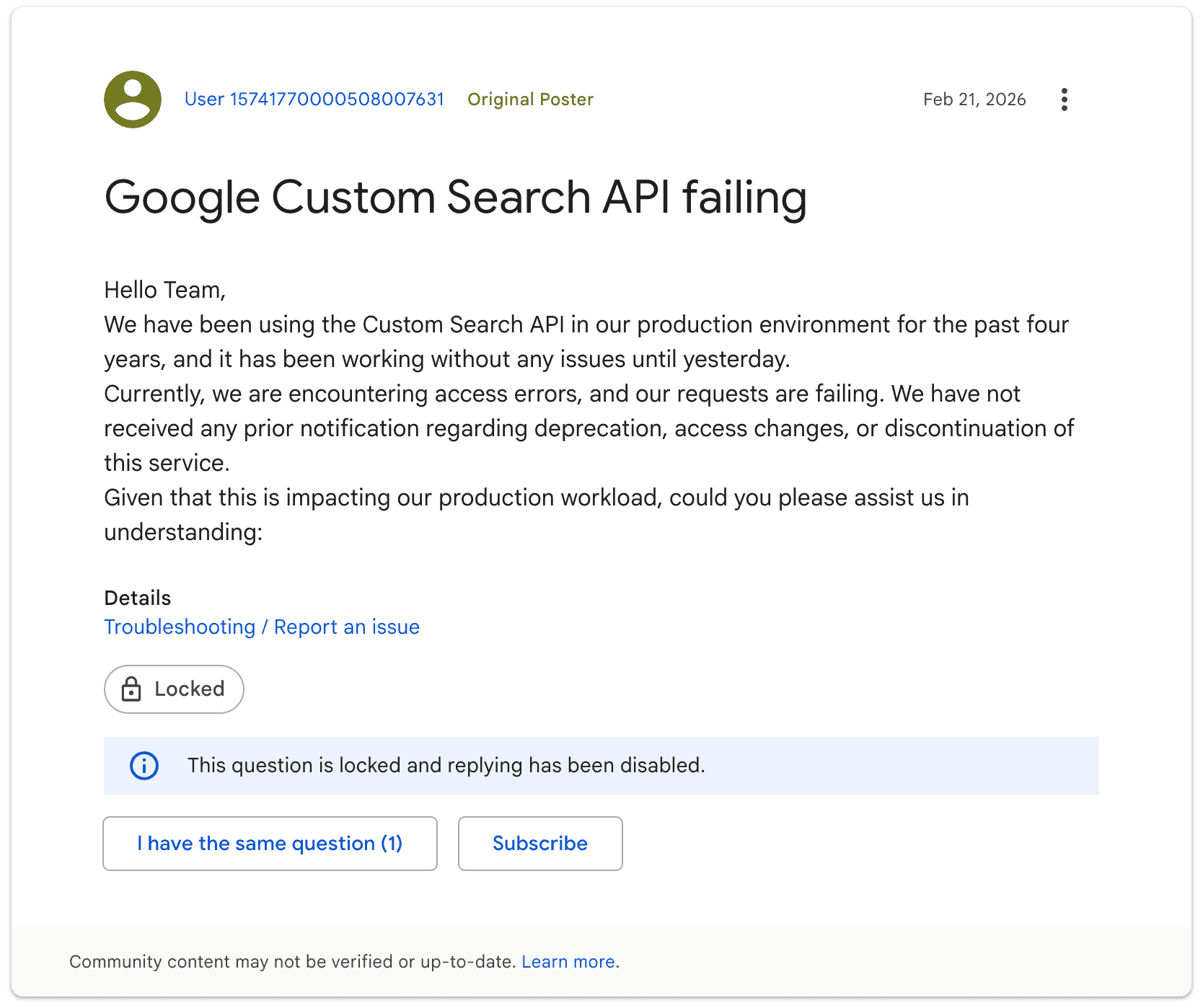
Here's what that looks like in practice.
The Programmable Search Engine has been frozen in time
The Custom Search JSON API still ships with the same hard constraints it had years ago:
- A hard cap of 100 free queries per day.
- A ceiling of 10,000 queries per day, even on paid tiers, at $5 per 1,000 queries.
- A maximum of 10 results per request and only 100 results per query total (you can't paginate past result 100).
These limits haven't evolved to fit high-throughput applications or the data volumes modern products demand. Google could scale this trivially. So the stagnation reads as a signal, not an accident. Watch these caps closely before you commit new features to them.
The push toward Vertex AI Search
Google's actual investment flows into Vertex AI Search, part of the Agentspace and Enterprise Search family. This is where the roadmap and the marketing budget now live. Google wants organizations to treat search as a component of a full, cloud-native AI platform.
That's a sensible strategy for Google. The trouble is what it does to everyone who isn't a large enterprise. Keep that gap in mind as you evaluate your options below.
The Enterprise Gap: Where Small and Midsize Teams Get Stranded
Vertex AI Search is genuinely powerful. It's also built for a very specific buyer. That buyer is not a two-person startup or an AI engineer prototyping an agent over a weekend.
Consider what adopting Vertex AI Search actually requires:
- A Google Cloud project with billing, IAM roles, and service accounts configured correctly.
- Data store provisioning and, in many workflows, ingesting or indexing your own content rather than querying the live public web.
- Consumption-based pricing that's hard to forecast and escalates quickly, layered on top of general GCP costs.
- A meaningful learning curve involving app configuration, tuning, and integration work before you get a single useful result.
For a developer who just wants to send a query and get clean results, this is enormous overhead. The old Custom Search API appealed precisely because it was simple. Vertex AI is the opposite of uncomplicated.
This is the enterprise gap. Legacy Custom Search withers while its "successor" is priced for organizations with dedicated cloud teams. Small-to-midsize developers are caught in the middle. That squeeze is exactly why demand for a practical Google Custom Search API alternative has exploded. Map your team's real needs against that gap before you shop.
What Makes a Great Modern Search API Alternative
It's worth defining what "good" even means in 2026 and 2027. The requirements have shifted since Custom Search launched. Search APIs no longer just power a search box. They feed retrieval-augmented generation (RAG) pipelines and act as the "eyes" of autonomous agents.
A modern Google Search API alternative should check these boxes:
1. LLM-ready output (clean Markdown, not raw HTML)
This is the single biggest shift. Legacy APIs return metadata-heavy JSON. Traditional scrapers dump raw HTML full of navigation and ad markup. Neither is ideal when your next step is stuffing content into a context window.
Modern pipelines want clean Markdown or structured text that an LLM ingests directly. No boilerplate stripping. No token waste on <div> soup. When you're paying per token and fighting context limits, tidy output is a cost-control mechanism. We go deep on this in our guide to integrating Google Search with LLMs. Test your output format against a real prompt early.
2. Native CAPTCHA and anti-bot handling
Maybe you've tried to roll your own scraper against Google. You know the pain of CAPTCHAs, IP blocks, and shifting HTML layouts. A production-grade API should absorb all of that infrastructure burden natively. You never see a CAPTCHA. You never rotate a proxy at 2 a.m. because Google changed a class name. Look for a provider that owns this layer end to end.
3. Low-latency synchronous calls
AI agents make decisions in real time. If your search call takes 8 seconds or forces an async job-polling pattern, the experience collapses. A modern search API needs fast, synchronous responses that fit inside an agent's reasoning loop. Benchmark latency against a live user request before you decide.
4. Predictable, developer-friendly pricing
No mandatory cloud ecosystem. No enterprise sales call to get started. You want clear per-request pricing and a real free tier for prototyping. You also want headroom to scale without hitting an artificial 10,000-query wall. Confirm the numbers fit your growth curve upfront.
5. Access to the live public web
Many "enterprise search" products index your data. But most AI use cases need the live, public Google index. Research agents and fact-grounding both depend on it. The alternative you choose has to search the real web, not just your uploaded documents. Verify live coverage before you build on it.
Evaluating the Options: A Head-to-Head
Let's put the three realistic paths side by side. Those are legacy Google Custom Search and a purpose-built modern API, with DIY SERP scrapers sitting in between.
1. Legacy Google Custom Search API
The good: It's official and stable. It returns results from Google's index. If you have an extremely low-volume, non-AI use case, it still technically works.
The bad:
- Capped at 10,000 queries/day and 100 results per query, non-starters for scale.
- Returns metadata-oriented JSON, not full-page content or clean Markdown.
- No roadmap. You're building on frozen infrastructure that Google is steering away from.
- No native page-content extraction for LLM ingestion.
Verdict: Fine for a legacy hobby project. It's a liability for anything you plan to grow. Treat it as a stopgap, not a foundation.
2: DIY SERP Scrapers (Proxy-Managed)
This is the "just scrape it yourself" route. Teams often assemble it from open-source libraries plus a rotating proxy provider.
The good: Maximum control and, on paper, low marginal cost per request.
The bad:
- You own the proxy management. Residential proxies are pricey and need constant rotation and health monitoring.
- CAPTCHAs become your problem. You'll integrate solving services and still eat failures.
- Parsers break constantly. Google changes its DOM often, and every change silently corrupts your data until you patch it.
- Compliance and reliability risk. Uptime is entirely on you, and one aggressive block takes your feature offline.
- The hidden cost here isn't the proxies. It's the engineering hours spent maintaining brittle infrastructure instead of building your product. If you do go this route, our walkthrough on how to parse Google Search JSON in PHP will save you some pain. Weigh those hours honestly before you commit.
Verdict: Powerful but high-maintenance. You're becoming a scraping-infrastructure company whether you meant to or not. Price your time in before choosing this path.
Option 3: DataBlue. A Clean, LLM-Ready Search API
This is where a modern, purpose-built service closes the gap. DataBlue's Google SERP API was designed for the 2026/2027 reality. It targets developers and AI systems that need real Google results without the operational overhead.
Here's how it maps to the modern requirements:
- LLM-ready by default. Results come back as clean, structured data, with page content as tidy Markdown, so it drops straight into RAG pipelines without preprocessing.
- CAPTCHAs and proxies fully abstracted. You never touch anti-bot infrastructure. It's handled natively behind a single endpoint.
- Low-latency synchronous calls. Send a query, get results back fast enough to sit inside an agent's decision loop.
- Developer-first pricing and onboarding. No GCP project, no IAM setup, no enterprise contract to get your first result. Grab an API key and go.
- Live public web. You're querying the real Google SERP, not a private index you had to populate yourself.
Verdict: The most direct replacement for developers who want Custom Search's simplicity plus the AI-native features it never offered. Spin up a key and test it against your current setup.
Quick Comparison
| Requirement | Legacy Custom Search | DIY SERP Scraper | DataBlue |
|---|---|---|---|
| Clean Markdown for LLMs | ❌ | ❌ (raw HTML) | ✅ |
| Native CAPTCHA/proxy handling | N/A | ❌ (you manage it) | ✅ |
| Low-latency sync calls | ⚠️ | ⚠️ | ✅ |
| Scales past 10k queries/day | ❌ | ✅ (with effort) | ✅ |
| No cloud ecosystem lock-in | ✅ | ✅ | ✅ |
| Maintenance burden | Low | Very High | Low |
| Live Google index | ✅ | ✅ | ✅ |
Planning Your Migration Off Programmable Search Engine
Say you've decided it's time to find a Programmable Search Engine alternative. The migration is usually far less painful than the platform switch implies. Here's a pragmatic sequence.
Step 1: Audit your current usage
Catalog every place you call the Custom Search API. Note your query volume and whether you rely on any Google-specific parameters. Critically, note what you do with the results downstream. Most teams discover they're only using a small slice of the response. Write that inventory down before you touch anything else.
Step 2: Identify your real output requirements
Decide what format your consuming systems actually need. If an LLM sits downstream, you almost certainly want Markdown rather than the URL-and-snippet format Custom Search returns. This step often reveals post-processing you were doing that you can now eliminate. Sketch the ideal output shape first.
Step 3: Run a parallel proof of concept
Point a small percentage of traffic at your new provider. Compare result quality, latency, and coverage against your existing setup. A modern API like DataBlue queries the live Google index. So result relevance should feel familiar while the output quality improves. Run it long enough to trust the numbers.
Step 4: Cut over incrementally
Migrate by feature or by service rather than in a single big-bang release. Keep the legacy key active during the transition so you roll back instantly if needed. Once metrics hold steady, retire the Custom Search dependency for good. Set a transparent metric threshold that greenlights the final switch.
The Bottom Line
Google isn't going to email you saying "stop using Custom Search." Instead, it's letting the legacy API quietly decay. Serious use cases get funneled toward Vertex AI, a platform that's overkill and overpriced for most developers and startups.
That leaves a straightforward choice. You keep building on frozen infrastructure with hard 10k-query ceilings. Or you take on the perpetual maintenance tax of running your own scrapers and proxies. The third path is a purpose-built Google Custom Search API alternative that delivers clean, LLM-ready results, handles the anti-bot infrastructure for you, and prices itself for teams of every size.
Maybe you're a CTO, product manager, or AI engineer who needs a stable, long-term search data partner. One built for the way software actually consumes search in 2027. DataBlue's Google SERP API is the modern default. It gives you the simplicity that made Custom Search popular, plus everything the AI era demands that Custom Search never delivered.
The search API landscape is shifting. The good news is that migrating off legacy infrastructure has never been easier. Grab an API key today and run a small proof of concept before your next release.